shame lives in our body, SO i'm taking it one day at a time
Written by: Tamar Simone Weir

When it comes to sexual health, desires, communication, and sexual joy, what I see happen often is some level of shame creeps in... sometimes slowly, and then all at once. It can feel dramatic like a big wave of emotion came and destroyed everything in its path, or more subtle as a quiet destruction impacting your breathing and sitting on your chest. For me, growing up shame crept up in little ways, although I lived in a very free flow home where my body was accepted. I think one thing that I didn't feel much shame about in terms of my homelife was my body image, and simply existing with a naked body. I was surrounded by green, and vineyards, and trees and birds. I was naked from a very young age, not aware or caring about the people who thought that being naked running around my farm was "Weird". I was encouraged to run around and to be free with my body, where in many homes, nakedness is not allowed and sexualized before people/ children even know what having a sexual body means.... Growing in this environment, did give me the understanding that nakedness is not wrong, and that being naked is not inherently sexual or involves sex, it is just a body in its nakedness....
In my early childhood and adult years, I was the friend that had that naked house, the friend that would take her top off at the river, and who would be nude for most of the time if I could. This was and is normal to me...
But as I developed into my more adult body, and I noticed changes in my body, society had some things to say! Lots of things to say.... I had a phase in middle school where I dressed up in crazy outfits, finding joy, excitement, and curiosity in my deviance away from hollister tight skinny jeans and fitted t shirts. I found an oasis in creating my own pathway for my fashion, but did the school administration like that? NO. Did the other students like that? NO. Did the male gaze like that? HA NO. Did most of the people like that? NO. I kept going with this creative flow, finding whatever items I wanted and incorporating them into my outfit. Trash bags? No problem I made that into a skirt. Pool floatie? Easy, it became part of my dress. Extra CD's? No problem, made those into earrings. And the list truly goes on and on.
While it was truly fun, and I still admire 2011 Tamar, it was not easy, I was constantly questioned, and bullied. I don't think there is a single day that went by those few years where I didn't receive at least one comment about my body/appearance.
Then in high school, I started dressing "normal", and was sexualized. I dressed for that male gaze, and received more attention, but now it was more acceptable, I was less bullied and now the eyes were on me in a different way.
In high school, I was a curious teenager. I was always interested in sex, romance, and relationships ( I guess nothings changed in that regard). So naturally, I was like what's up with all this sex stuff? How do I get in it? Or rather how does someone get in me? If I had the knowledge I have now... ooooo things would have been so different, but like most of us our younger years were filled with confusion, shame, and little to no communication.
Then in college, I really began my hoe journey, and this broke down the walls, and allowed me to get into the thick of things. I explored a lot, got herpes from one of my partners, became and started exploring polyamory, did anal for the first time, you know... the things. As I found my voice, and continued to nurture it, I noticed so much shaming for sexual preferences, for desires, for needs, wants, boundaries, limits. Speaking my truth, describing exactly how I wanted something, and communicating was not often met with the same transparency and openness. It was seen as something that was "too much" for many people.
Being in my hoe era, and also having herpes filled me up with lots of tears, of feeling so deeply misunderstood and rejected. It made me have a tough exterior, it was exposure to rejection again and again. It was learning to actually say what I like. It was learning to have awkward conversations.

Now in 2026, as I delve deeper into my sex education studies, I am seeing again and again how much shame permeates our bodies, minds, and souls. This is on an individual and personal level of course, but also a collective shared level.
Understanding shame and how it affects our sexual health is so important. Sexual health to me is more than just if your genitals are "functioning", it's about how you feel about your body, how you relate to your body in its changes, and access to education that empowers people to live freer erotic lives.
How and When does shame show up, and patterns/behaviors?
Perhaps...
being naked in front of others?
looking in the mirror?/avoiding mirrors
avoiding certain clothing/textures/colors
when receiving touch
when receiving care/affection
struggle receiving compliments
avoiding intimacy
going through the motions, but not feeling there/connected
feeling checked out when things get hotter
always "performing" sex
saying yes, people pleasing with receiving /giving touch
feeling guilty when either saying yes or no.
What do you feel shame about ?
When shame is so present and taking up so much space, it can be hard to open up conversations with people about how you are feeling, or where shame lives in your body. And over time, this can lead to shame growing bigger in our bodies, and or other associated feelings with our shame.
We can't talk about shame without talking about trauma. And this word gets passed around a lot, but something crucial to me is that there are levels of trauma and the stress that creates on the body. Trauma is not only about big events or big moments, and all people cary traumas of varying levels and in some way. Trauma does not always provide us access with choosing what we want to experience, and can greatly affect our nervous system during sex/ moments of arousal.
There are lots of different types of traumas:
shock trauma
chronic developmental trauma
neglect trauma
intergenerational/ancestral trauma
secondary trauma
community trauma
chronic micro trauma
vicarious trauma
sexual trauma
religious trauma

Some people have studied shame as it relates to our sexual experiences. A recent study conducted in 2023, analyzed the effect of sexual shame, emotion regulation strategies, and gender on sexual desire. A total of 222 participants in Norway participated and results showed that Results showed that cognitive reappraisal, but not expressive suppression or sexual shame predicted participants’ sexual desire. The study did "not find gender differences in sexual shame, sexual desire, and cognitive reappraisal, which has been found previously in older studies. However, the use of cognitive reappraisal in everyday life was found to be associated with increased sexual desire, at least in women. Results from the current study indicates that the inclination toward cognitive reappraisal as a preferred emotion regulation strategy may positively affect the strength of sexual desire."
Another study conducted in 2021 analyzed women with body dysmorphic disorder in relation to exploring their sense of lived experience with intimacy and in the context of their current partner relationships. The study demonstrated how appearance related insecurities and concerns affect cognitive, behavioral, and emotional spaces of physically intimate partnerships. They generated three main themes that were prominent 1) The shame in being seen 2) disgust and detachment during physical intimacy 3) A flawed self, feeling unworthy.

The impact of communicating with our partners, and with our OWN bodies is really important. Beginning to have conversations about shame are not easy, but these are not secrets that need to be tucked away in the back of the drawer forever. Not everyone will understand, or be able to listen and truly hear you. Sometimes we cannot even hear what our own bodies are telling us about our shame, and where it lives. and when it shows up. Suddenly we get a wave of chills, and we are reminded oh yeah, that tender spot I carry with shame, it is still in me even though I thought I "dealt with that years ago". It's an on going, living, breathing, process of tenderizing our experiences and what they mean for each one of us.
Can we slow down to notice, when our bodies are screaming, whispering, singing, or in a shame spiral?
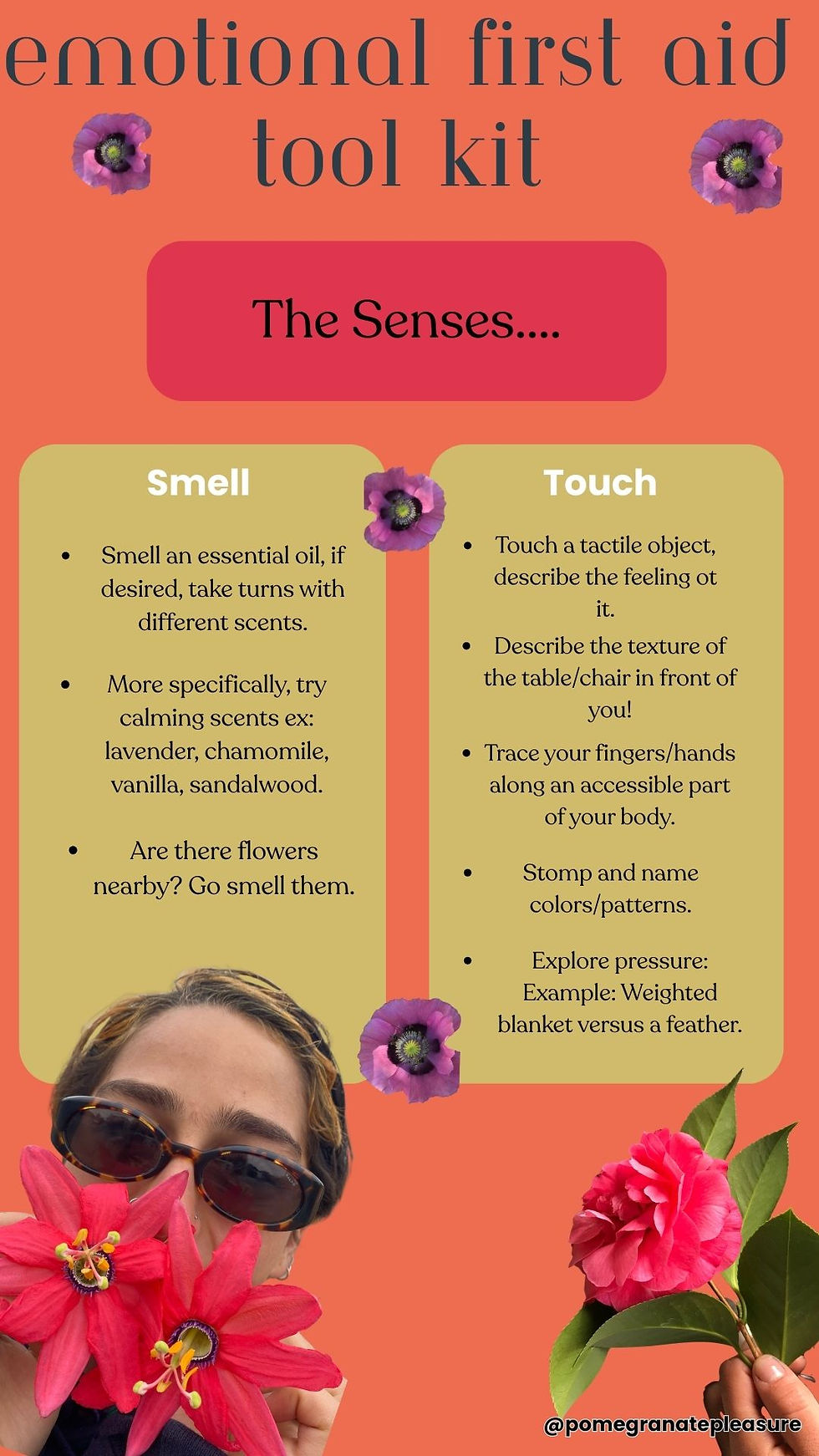
below is a 5 page infographic about different potential practices for getting grounded and emotional first aid.



Comments