Written work
in Intimacy, Love,
Pleasure, and Sex.
Who the fuck am I?


how did i get from this to this?
educator/writer/poet/advocate/
individual/creator/curator/lover/
imaginator/play/friend/farmer/
fruitlover
Tamar Simone Weir is a Iranian-German, California born and raised queer woman. She grew up in Napa California, in a family farm, where she co created a sustainable, and multigenerational food forest! Her passions are working with her hands, creating art wherever she goes, sexuality, sexual health, and agriculture! From a multicultural background, she identifies as a mixed queer woman, dedicated to narrating complex histories using words and stories.
She received her bachelors degree in Sociology and Education at the University of California Santa Cruz. She then went on to receive her certification in Sex and Intimacy Coaching through the Sexual Health Alliance program. She is an active student at the Institute for the Study of Somatic Sex Education.
Her work has been published in the Leviathan Jewish Journal, Witch in the Woods, and Mixed Magazine.
When she is not talking or writing about sex she is, traveling, trying to complete her 1 million unfinished projects, spending time with her family, and probably stealing fruit from unpicked trees around the block!
If you are here, thank you!
I know there are a million other things you could be spending your time with.
XOXO

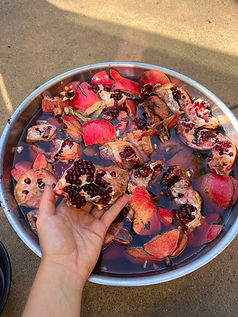
Pomegranate Pleasure : The Manifesto of an Erotic Life in Exploration
I believe in the power of the body, in the messiness and resilience of being in the I Don't Know. In the ways that our bodies hold stories, and through sensation we can begin to be in conversation with what lives inside of us, and what wants to come out.
I believe in the power of education, in co-created spaces for us to learn from our bodies intelligence, our experiences, and what is erotically possible in our imaginations. \
I believe in the power of community, of witnessing others in their grief, pain, sorrow, joys, heartbreak, and heart openings. I believe in the capacity of our bodies in protecting us, in keeping us alive, and breathing, and that our bodies are beyond intelligent.
At the same time, our bodies capacity for pleasure is vast, like the river flowing downstream, we too can access immense feeling by going in the water.
What can arise when we truly speak with our yes, our no, and our evolving maybes?
What shifts when we learn how to listen to these messages, and to communicate them with others?
-feeling heard, understood, a softening in the muscles, a conscious release of needing to be perfect or protect others.
What happens when we see pleasure as more than orgasm or sex, but as something that is expansive and in every day?
We are all imperfect, and our bodies are not meant to be separate from our relating and existence on this earth.
Through attention, care, curiosity, and intention, we can bring new stories, and new touch that fills our bodies with tenderness and warmth.
As a practitioner I honor the lineages within my blood line that have allowed me to be here today engaging in this work. I honor the lineages and ancestors that are all around us, and present. I come this work with my identities close to my heart and to my practice, as a queer mixed, woman.
As a practitioner I bring my queer, farmer, mixed, artist, weirdo self to the work, and to my perspective in my approach every day.
I want my clients to feel:
-empowered
-safe enough
-encouraged to show up exactly as they are
-release the need to be perfect
-erotically alive
-curious about their bodies capacity to feel
-build capacity for pleasure through sensation noticing
-unlearn harmful sex ed from societal narratives/stereotypes
-see pleasure as more than just a standardized one size fits all sex act
I believe that we all need this work, and we should all have access to this work, that gets us in deeper connection with our bodies, and more acceptance for our desires.
Search Results
Search this site
52 results found with an empty search
- People are having less sex now than before.. but why?
Written by: Tamar Simone Weir For whatever reason, people are having less sex today, now.. than ever before. When I first learned this I was surprised by this information. Really surprised... When I repeat this to others, people are shocked and in disbelief as well. With all the increased awareness in the vastness of sexuality and the emerging fields of sexual health, coaching, pleasure, and healing, it seems odd that the numbers would show a decrease rather than an increase in sexual activity.... There are many ads & visual stimulus around us that convey sexual messaging, especially in movies and in the hollywood industry. I know from my own experience, that as a teenager, sex for me was about exploration and curiosity, but also discovering the harsh objectification of my body by others, and my own complicity in this dynamic. As a young teen, it felt good to receive attention by others, as this was my proof that I was desirable in this society, and that my growing up was seen by others. I received a lot of unwanted attention, and I also was interested in the risk of playing with this attention, and therefore my "desirability". I would put myself in situations to see what would happen. Challenging the lines, and the narratives around me. And I was validated by these lil boys saying sexualized comments about me, and then crushed when it was the opposite. I remember hearing many times that I was the "ugly one" in the group of my middle school friends. At the time this hurt me a lot, as I was so hyper fixated on being beautiful and adhering to the beauty norms of the beauty standards of the time. My self esteem, even though it was my own, didn't feel like my own, as the context outside of myself was fueled by sexism and gendered roles all around. All of our experiences in our youth and adolescence is deeply woven into the fabric of our sexual attitudes, feelings, and beliefs. About ourselves, like our self esteem, and about others, our biases and relationships to other people. Enjoy this lil graphic I made for my instagram page @pomegranatepleasure, give me a follow:) I'm definitely having less sex than I was back in the day. There are many reasons for this change within me. This is partly due to the fact that I am more aware of how my body is feeling and how I am feeling emotionally, so I am less likely to engage in any sexy time if I don't have the desire within myself or feel comfortable in that moment. A real reason why I am also not engaging in as much sex is because I am more conscious of all the layers, symbolism, and components that go into a sexy exchange/dynamic. I am more aware of the different desire spectrums, the emotional aspect of this intimate exchange, peoples complicated and deep relationships to their bodies and other peoples bodies, more open about pleasure as something that is expansive rather than a universal limiting box. Another reason I think my sex life has gone down in frequency, is that I am not living with the idea that "more sex is better" I am living with the idea that quality is more nourishing than quantity. Back in the day, that was the opposite for me. I wanted to collect as many sexual experiences as I could, write them down in my diary, talk about them with friends, cry, laugh, and use my body for exploration. BUT what was missing was this internal knowing of my own compass, that I now feel inside of me.. This compass helps me to discern whether I really need or want to be in a sexy situation, and that saying yes is not always the best choice for me. I'm so thrilled with my younger self that said yes to everything, that is why I am here now, as a sexy educator/coach, because of that sassy girl who said yes to life, lust, and sex. The National Survey for Sexual Health and Behavior used data from their studies in 2009 and 2018, which was conducted online for participants aged 14-49 years old. In their findings, they collected data from 4,155 participants for 2009, and 4,547 for the 2018 study. The great thing about this study is they included questions about sex that included diversity of activities, including penile penetration, but also solo masturbation, partnered masturbation and oral sex. This opens up the conversation quite a bit, as previous studies asked questions that only pertained to penis in the vagina, penetrative sex, which is quite limiting and only provides certain results in the analysis. The researchers found that, in the 2018 study, participants were having less sex than in the 2009 study. This study found an overall decrease in sexual activity for the participants, and the common hypothesis of aging and the decrease in sexual desire is not relevant here as the population did not exceed the age of 49...... For both adolescents and adults in the study, they found decreases in partnered sex of all kinds, and for the young adults and adolescence a decrease in their solo masturbation practices. There are many potential reasons for why we see an overall decline. In the Scientific American, " People Have Been Having Less Sex—whether They’re Teenagers or 40-Somethings" the authors discuss how social media and gaming plays a big role in the decline that we see from 2009 to 2018. They notice that without the heavy presence of constant online interactions from new entertainment streaming movies, or online games, social media trends and much more, there is constantly something to plug into instead of participating in sexy time... This makes a lot of sense when you think about how much time we as a collective society spend scrolling on our phones, talking to people, messaging, watching videos, I mean the list goes on and on. There is always something to do on the devices, and with access to more and more 24/7 there is no end. People are definitely spending much more time on their screens, and less time with people, 1 on 1. I know that while I deeply value quality time with the people I love and my lovers, my phone gives me the alert of how many hours I was on my screen that day and it is always a lot higher than I expect or want.... The authors also bring up the fact that we see lots of changes and people processing the effects that COVID has had in their lives directly and in the lives of their community. Many people suffer from long term effects whether it be physical, emotional, or communal in the aftermath of the global pandemic, and this is affecting their relationships, and therefore also their sex life..... We also see the authors discussing how the conversations around consent ahve become more widespread and frequent which could possibly have led to people being more conscious and aware. WE LOVE THAT. The more people are aware of boundaries, limits, and abuse, the more we can analyze and identify how these power imbalances are created and shift the narratives of abuse/coercion. Rape culture is widespread, it is living and it is continuing, and so is the dismissal of people stories of discomfort, not feeling safe, and so many forms of abuse on this spectrum of consent. But, the authors claim that this generation is understanding the complexities of consent in a deeper way than in the previous generation which makes people more cautious about beginning sexual relationships, approaching people, or initiating something sexual. I can speak to this observation even within my own life in the last 5, or 10 years... I am much more aware and deeply in the knowing of the vast spectrum of desire, attraction, and consent that is necessary. I don't always have the answers or know what to do/ how I am feeling in a sexual scenario, but I do know that I create conversations for deeper listening and understanding. I am less likely to just go ahead and kiss someone, or go ahead and touch someone's body without there being a clear moment of communication or established dynamic. Another interesting point that Herbenick highlighted was that this decline could also be due to the economic hardships and lack of economic opportunities that people have in this generation. The cost of living and surviving is increasing, and long gone are the days of being able to afford a home for your family or yourself with a teaching salary.... More and more people are living with their families and cannot afford a lifestyle that allows them this freedom of going on lots of dates or pursuing these relationships with the same intensity. As someone who is living with my family in order to rethink my life, and to focus on my studies, I can confidently say it is a privilege to be able to come back to my family's home and feel safe, feel space to breathe amidst the chaos and destruction of the world. AND yes, in these economic times like going out and dating, spending all this money on the dating lifestyle while also trying to focus on yourself is hard. Me being erotic with this tree, but was it sex? We cannot say it is one thing that is the "reason" for this decline that we see consistent in this study, but what we can say is that there are various possibilities and hypothesis, all being possibly true and real.. My opinion on this debate that we see circulating more and more is that people should do what their bodies and soul tell them to do. If you are feeling internal and do not want to engage with people in a sexual way then don't. If you are feeling desire to be touched and to be held, to share that space with someone/people then go for. it. If you are curious and don't know where to start maybe try making a list and surprising yourself with what gets put on the page. What truly matters is how you feel about wether or not you are or aren't having sex. There are countless reasons as to why you as a person or me as a person could be not having sex right in this moment... and we can get real creative with it. Some reasons why I haven't had sex in a while are: -living in a small town -hard to find other queer people to bang -i go to sleep early/don't go out much -not investing my time in dating at the moment -have a few long distance lovers I don't get to see too often -live with my family Some reasons why I have had sex in the past: -ovulating and wanting to feel good -genuinely like a person and want to explore their body -it feels good -have free time -makes me feel alive -makes me feel like I am getting to know myself more Please enjoy this beautiful edit that my partner Diego made for me<3 I will end this exploration with the famous and fabulous quote of the queen Ester Perel, "Sex is not a thing you do, it's a place that you go"
- Erotic Literature; what's said and unsaid. An in depth Interview.
Written by: Tamar Simone Weir https://www.invaluable.com/auction-lot/erotica-4022-c-c224c368df I love asking people about their passions..... To see how they become ignited while speaking about what turns on their flame. And as you all know from reading my blogs, or maybe you are just starting to find out now, I am very passionate about all things sensuality, juiciness, and sex. I recently went to a friends house, and to my surprise discovered that her housemate is in grad school. She is focusing her thesis on erotic literature..... I couldn't let this amazing opportunity to dive deeper into the erotic with a fellow erotic appreciator and feeler pass me by, so I asked to interview her and we got into a beautiful discussion. I will highlight some main points of our discussion, along with the questions I asked to guide our conversations. I hope these questions can help illuminate some juicy findings from our literary conversation, and that they ignite more passionate thinking and feeling for you all <3 What inspired you to begin studying and researching erotic novels and literature? Victoria was inspired to study this work when in her undergrad education she learned, that in the 1600's up until the 1800's, novels were seen as not real art, as they were knew on the scene. They formed in England in that time period (although the specifics are debated within the academic community). Everyone thought they were feminine, and that men should not engage, but that at the same time by reading books it would make women loose, bad, and corrupt. Hearing about this heated discourse around these novels, allowed her to understand that literature is so dependent on time period, place, current debates etc. Romance and erotic fiction is still seen as feminine art forms and as not real art. Because of that she was interested in looking at that academically. What you privilege with your study is like acknowledging this active art that is not respected even today... Novels were once not respected and then they got more masculinized and now everybody's like that's the best art form ever!! That is what got her into this topic at first, looking at the underlooked and understudied. We both agreed that it is significant, because what you decide to focus your time, energy, and research on, gives that topic a place within the discourse of the people around you, and giving it a place creates deeper meaning. How do you think your various intersecting identities play into the way you read, integrate, and feel when you are investigating erotic works? Victoria feels that she reads the work with the identity of being a white cis woman, who is able -bodied and straight. She brings those identity markers that hold privilege as she reads erotic/ romance novels. Victoria notices that in the novels she investigates, they are very exclusionary in the sense that the novels themselves are all about white and straight people. Many novels as a whole take the privileged experience of white straight people and create an illusion that this is universal, and the communities around these kinds of novels has also been very white and exclusionary from what she understands. She tries to keep in mind that those identity markers bring her closer to the oppressive societal ideas of desirability. Romance novels are so concerned with that concept, one that society continues to uphold through the structures of beauty and heteronormativity. Victoria highlights how another scholar named Ria Cheyne writes about disability in romance and genre fiction. Ria discusses how novels decide who deserves a desirable future, so when Victoria dissects these novels, she thinks it's important to keep in mind and to analyze the harmful stereotypes that are embedded into the genres that model desirability and what is the erotic. Victoria states how a lot of the groundbreaking erotic analyses are all done by really brilliant black female intellectuals, and she is indebted to their work. Those identity markers remind Victoria of the ways that these spaces have been in the past, as she is trying to make them less like that in the future. The way that Victoria integrates and feels the erotic work as a woman connects to the ways she feels our sexuality is not centered. She remarks that it is so fun to read these novels that are so much about the female perspective, what is hot from that perspective, and that helps Victoria integrate and feel them. As I listened to Victoria share about her thoughts, I reflected on my own feelings about how society dictates and states who deserves and can receive pleasure through the erotic. The larger concept of desirability, and what societally we think a body can do, or should do is projected on to other people, and in the ways that people write the work. I noticed that it must be uncomfortable to be embedded in the research of reading these works as it so closely connected with what our society is allowing through the power of words. In terms of being in the thick of the process of reading and feeling, we both agreed that its a lot more fun to read work that feels liberating rather than constricting when it comes to sexuality and stereotypes..... What do you think about the erotic / romantic genres of novels today? Victoria thinks that the two genres are blending. SO many romance novels are like also erotic and so much of the erotic novels have a lot of romance. She loves it. A friend of Victoria's influenced her in choosing this topic for her thesis as well, because her friend is really into a popular romantic novel series. Victoria exclaims that the reading process takes her back to when she was 13 and reading Twilight, the feeling of being giddy and staying up late to discover what happens to the characters is fully encompassing. There is something about the romance genre, that creates this feeling of "I have to know what happens." Victoria loves the ways that romance novels bring people together in conversation, and shares a story about how her co workers and her got into the best romance novel recommendations the other day! She shares that one of her favorite book stores in LA is called "The Ripped Bodice" and is purely dedicated to romance novels! She loves how this space creates community by having events, and encouraging people to be in discussion together. Victoria is looking at both of the genres, and trying to decide what will be her focus in the future, but this summer she has been reading more erotic fiction. Although in the past she has read more romance novels, she feels that romance today has a lot of fantasy elements that break societal norms which she loves and thinks is very JUICY..... I definitely agreed that there is something addicting and energetic about a good romance novel that just completely transports you and sucks you up into a different dimension. Romance or erotic fiction can be so intimate and I think so many people are starved of intimacy in their lives, so to me that feels like a relevant reason as to why these genres are so alluring. Although, each person's situation and own personal life might influence what their response is to these works... Another amazing part of these erotic and romance novels is that you get to live and absorb the new relationship energy by proxy, which is extremely fun. It feels almost real, and then you can put the book down with no larger stakes while still experiencing that rush!! We agreed that most people could use to read a bit more erotic and romantic novels, especially since there is so much more nuance, variety, and potential for joy and satisfaction. Everyone needs a lil more romance in their life, and it's beginning to feel like there's a little bit of something for everyone to enjoy. https://www.fnac.pt/livre-numerique/a4770478/A-Wife-s-Secret-Lust-Vintage-Erotic-Novel How do you feel reading erotic works has impacted your sexuality/erotically? For Victoria, reading these works especially the stuff that is new and popular has made her feel more comfortable talking about sex, the erotic, what turns her on etc. When she is at a party, and people ask her what she studies, she confidently says porn, and just laughs because her levels of confidence within herself has increased. With her partner, they are now reading erotica together out loud which has been a fun and sexy process. The impact she has witnessed in herself so far is the overall comfort she feels in talking about her own sexuality and preferences with pretty much anyone now, which has allowed other people to open up to her as well. Depending on the vibe (never wanting to push), she is open and ready to talk about all those juicy topics if they are open as well. I have also noticed that with my own work and school right now, I am being opened up in many ways. I study the erotic in my own work, which has opened the doors for larger conversations with people where the overall attitude is one with a sex negative culture but here we are trying..... People ask me what I'm studying and then are not able to receive the answer.. I'm like always surprised that they are surprised that i'm not studying something that's been studied a million times..... How would you describe the difference between the two words, sexual and erotic? Victoria feels like erotic is so much more expansive than sexual. Sexual is wonderful, but the erotic is so much deeper. Eating a nice piece of fruit, or going for a really good swim, the erotic is more about the experience and feeling. Victoria really resonates with Audre Lorde's, Principles of the Erotic, where she talks about how the erotic is a deep understanding of our capacity for pleasure and enjoyment. Once we realize that, it allows us to seek more enjoyment and know what we can have, what we are worth, and what we want. This ties to our work, communities, and activism. Victoria really appreciates Audre's look on the erotic in that way. Victoria has also been reading a book called "Erotism" by Georges Bataille, where the author discusses how the erotic and death are connected. The author says we live these separate lives, we have our separate experiences, but how in death and in the erotic we can feel more continuity and connection. Victoria likes that idea too about how the two are related, and creates a feeling of transcendence. Victorias words made me think about death doulas, and how birthing can be very erotic and a lot of feeling/sensation there. Similar to death being a portal, birthing can also be a portal, and I see the erotic links between the two. I think in erotism, its beautiful to highlight death and birth as these are seen as the beginning and the end, and it is just such a cyclical part of life where we experience beauty and pain all in the same lifetime. What do you think society has to gain in appreciating and celebrating erotic works? Victoria feels that in studying the erotic it is a way to fully experience life, even the painful parts of it. An appreciation of pleasure in the small things too, it can be something as small as taking a shower. It can help us understand ourselves, our shame, guilt, and looking at those things creates liberation. Romance helps people see the ways that they want to be loved, and if they haven't had those experiences in real life, reading about this can give more insight into how it feels to receive those things. Thinking of my own response to this question, I find myself struggling to answer, it gets me emotional thinking about all the sexualphobia, erotic phobia, & whorephobia. Even within myself I have these biases that have lived inside of me from so much societal conditioning, that I continue to unpack on the daily. People have so much resistance to the erotic, because I feel that it can open up portals for feeling. It's hard, and I empathize, society has so much to gain in valuing people's erotic experiences. I think society is scared of erotism as a whole, and this is different than the sexual, it is even more nuanced. We know society hates the sexual, but when it comes to the erotic it is harder to even describe because it encompases so much, but even within that society is so anti erotic!! Victoria exclaims how in a capitalistic society the erotic being about pleasure, sensation, and experience is the opposite of what we are encouraged to do/seek. Instead of being productive, making money, and making your time "count" erotism goes beyond and through that bullshit!! Anonymous, Woman Reading, Japan, circa 1910s Do you notice any main themes of eroticism and sexuality present in the many books you have read and analyzed? Victoria has recently been reading some of the so called classics of erotica. One in particular is called "The Story of the Eye , published in 1920's. The second, "Story of O" published in 1950's. Both those novels talk about the unconscious and how it impacts our experiences of the erotic. They also go into BDSM and the elements of what we get from submission, abandoning oneself and the positivity of that power. Victoria is also reading the Sleeping Beauty series by Anne Rice that goes into the sleeping beauty story but told in a BDSM universe which is fun, & highlights the power in submission. The more general themes she has found in the romance novels she has analyzed are, finding your voice, overcoming trauma, going through the exploration of their erotic experiences. How do you think romance is connected to eroticism, and how is it distinct? Victoria feels like eroticism is so personal. Romance is a more specific thing. Eroticism is more multifaceted. Victoria feels you can have one without the other, but then as she answers this, she rethinks that as lots of times they are so connected. I was curious about this distinction because some people have specific definitions of these things, and are more rigid about what is sex, what is erotic, what is this and that. But then other people see all of this as combined and within the same umbrella. Victoria feels that there is so much that can be romantic outside of romantic partnerships/relationships. Doing something by yourself can be so romantic! Victoria concluded that she doesn't really know what the difference is between the two, and I agreed that it's okay not to know, our definitions are constantly expanded and shifted, nothing is universal! Uses of the Erotic: The Erotic as Power by Audre Lorde What is your take on the argument that erotic art or literature is distinct and different than pornographic content? Victoria hesitates to draw distinctions between what is literature and what is not because there are so many brilliant people who maybe she is not drawn to initially but someone else might write the most brilliant essay about it and then she can change her mind... Victoria thinks that people have used the term pornographic to demonize erotic and romantic literature... Erotic literature is pornographic, but also she feels that there can be porn that is literature. There is not a clear distinction between them. But typically, people refer to pornographic literature as less respected than erotic literature, but Victoria doesn't agree or feel that that's the case. I also was curious to ask this question as there are so many sex negative ideas and whorephobia in our culture that people will go so far as to defend things and create stories of how something is not pornographic to validate the work. Pornographic as a concept and word is not a bad word, although it is othered in the world of the erotic. I believe that if someone feels it creates more liberation for them to create a distinction between the two and can also acknowledge that they live on the same shelf together then we can have deeper conversations. I do feel that watching versus reading erotic work is a different experience. But I think that it is interesting to analyze the hierarchy present within the categories of fiction writing, whether it is erotic, pornographic, sexual sensual, romantic etc. How much of something has to be in something for it to be erotic vs pornographic vs romantic?.... . Lady Chatterley's Lover written in 1928 is very erotic and at the time people exclaimed that it was so pornographic. Its definitely not as explicit as any of the sexy scenes you will find in Brigerton, but they banned the book because of the "pornographic content." Victoria believes that a lot of the work that is written now would be called erotic more than pornographic because of the time period in which they were written. And we agree.... that the main reason people are watching Bridgerton is because of the sex scenes. Cmon ya'll..... From your research thus far, what books or authors would you recommend people be open towards reading, what literature would you recommend to the masses? Victoria was so excited to answer this question as she developed an extensive list!!! -Anything written by Audre Lorde - Pleasure Activism by Adrienne Maree Brown - The color Purple AND Now Is The Time to Open Your Heart by Alice Walker -Any Mary Oliver poem! -Mina Loy's poem "Parturition" - "A Court of Silver Flames" by Sarah J. Maas -"Sleeping Beauty Series " by Anne Rice - Heated Rivalry by Rachel Reid - Fantomina by Eliza Haywood MORE recommendations to come as Victoria continues reading and deeply diving into all the novels out there, from the past, present, and into the universes of the erotic..... Evelyne Axell’s Paintings
- What is Sex? And what "Counts"?
Written by: Tamar Simone Weir I have had a list of all of my sexual partners, from the beginning of my sexual journey. On the list I organized the names of the people, and the way that my high school brain categorized things was that the names with an emoji indicated that we had had sex, the names with no emoji meant something sexy and flirty but no S E X... For years I added to this list, adding sexual experiences to my portfolio, figuring out my body, having lots of unsatisfying sex, having some beautiful explorative moments, and then something happened.... Street Art in Chiapas, Mexico. At the age of 20 I decided to follow this curiosity that I had had for a few years, in exploring with women and non cis men. To follow this curiosity and explore this desire within myself! While I was in this process of internal and external thoughts and actions, I realized that my list was heavily flawed.. I was indicating with an emoji the people I had had sex with, but was not including oral sex at all. In this list the people that I shared oral sex with were not included as my sexual partners..... This shook me in a deep way because as I was exploring what it meant to be queer for myself and for others around me, my list was not inclusive of the grandness of sex, the expansiveness of it, and the vastness of experiences one can have within the framework of pleasure. This is something that I still find incredibly common within many social circles, where people are not inclined to think that oral sex or sensual actions done with the body that don't include penetrative vaginal sex, is sex......So for many years my little list was smaller than I thought right? Because here I was not including all the other sexual experiences I had explored which were many,.... but after this rude awakening, I forced myself to go back to this list and do some heavy editing. Some major changing of what I knew to be sex and what misconceptions I was carrying with me through my exploration in new experiences. The ignorance I unknowingly or unconsciously carried with me for far too long, was confronted and in that, I had to acknowledge the ways that I had erased pleasure for queer folks, for myself, and for many communities. The patriarchy was thriving off of my patriarchal sex list, but no longer... The Oxford language Dictionary defines sex as, " ( chiefly with reference to people) sexual activity, including specifically sexual intercourse." Today talking about sex is still very taboo, and when it is discussed many topics are left out of the conversation. This definition is known as one of the many vast definitions of sex. It is not the only definition even though society and media likes to portray that there is one universal definition and standard. That this word is a non fluid and stagnant word that remains untouched. This relates to how each person defines their experiences in their life as well. Time and place is also extremely relevant as society is molding us and creating narratives around us as we live and breathe. The Harvey Institute defined 6 principles of sexual health as a way to investigate and open up conversations with friends, family, and lovers about what a healthy sexual life can look like Consent Non -Exploitative Honest Shared Values Protected from STI's and Unwanted Pregnancy Pleasure To explore more of the article and the ways that they define these concepts and why they are important, take a look at the full article above! How do we define our love and health in conversation with our sexuality? What 6 principles and terms would we use if we created our own personalized principles of Sexual Health? For instance, a topic that gets circulated often is cheating.... but even within that heavy word, there is a lot underneath to unpack. What is cheating for you? For your partner? How would you define this word specifically? Is cheating when you engage in penetrative sex with someone else that is not in your clearly defined relationship? Is it kissing someone else? Thinking about someone else? Flirting with someone else? Dreaming about someone else? Emotionally creating a connection with someone else? What is included and excluded from the conversation greatly depends on each person's connection to the experience at hand and the ways that they view the world around them, impacting the way that they come to define a particular situation. The same is true for this large HUGE umbrella term SEX. When we see sex as only penis in the vagina, we are minimizing the potential for pleasure and furthering the heteronormative agenda that states that there are wrong and right ways to experience our bodies. That there are bad bodies and good bodies, and bad ways to experience having a body and good ways to experience having a body. The patriarchy tells us that we need newness and to change ourselves constantly. The patriarchy tells us subconsciously that having a penis is more valued than a vagina. That men are more useful in our society, appreciated, respected. Heteronormativity tells us that we need to perform sex, and pleasure in certain ways to be accepted and valued as sexual beings. That to deviate from the norm is weird, pathological, disgusting. A study in the National Library of Medicine , investigated how heteronormativity functions in young people's lives, and the ways that gender, sexuality, and sexual attraction are performed. The study interviewed 14 young people, and 4 major themes were identified. (1) challenging gender norms, (2) gender expression (in)validating sexual identity, (3) the role of gender expression in attraction and partnering, and (4) negotiating gendered family formation. This study is important for many reasons, one being that they investigated how these young people feel about the presence of heteronormativity in their lives with an intersectional lense. The prevalence of heteronormativity in these youths lives, was a great predictor of the ways that they felt like they were engaging in the world, their identities, and navigating their own life's experiences. At first glance, sex for someone may not be a gendered act, but at second glance it really connects with so many of our core fundamental belief systems that our collective gender binary imposing society inflicts on us unconsciously EVERY SINGLE DAY. Christina Greta, author of "Are We Having Sex Now or What" offers her own insights into what we define as sex. Below I am including the first chapter of the book. In this work, she includes a working definition and possible definition to this large question. Sex as, "T he conscious, consenting, mutually acknowledged pursuit of sexual pleasure of at least one of the people involved. That it can be messy. Feeling sexual with someone isn't necessarily the same as having sex with them." She then concludes the chapter by stating that she still does not know what it is.... And for many people, having this nonlinear and expansiveness is a challenge, because we want to label things and have clearly defined concepts that we can grasp. Can we continue to have sex and be sexual while opening up our definitions and not attaching ourselves to one definition? I think within the larger framework of sex and especially given how deeply personal it is, it's crucial to also talk about some important concepts. A not new, but definitely more mainstream term that has come into the public eye is Sex Positivity . Some describe it to be a movement, some describe this as a framework, and some describe it as actions that you participate in, actively. Many people have their own definitions. One that I particularly enjoy is from the author of Come As You Are, Emily Nagoski. She states that Sex positivity is “the radical, all-inclusive believe that each person’s body belongs to that person.” Film Photo taken of me by a dear friend, in Santa Cruz 2021. For me sex positivity is a daily practice in unlearning shame based feelings and emotions in the body, that lead me to feel negatively towards myself and others. It is not yucking someone's Yum. It is allowing for possibilities to arise. It is the not knowing but exploring. It is the awareness to begin questioning yourself and your beliefs. It is the sadness of disconnection from my body but allowing the tears to fill me up with fuel. It is the movement towards pleasure. It is the knowing I'm worthy. It is the fluctuation of desire, confidence, sensation, appetite, hunger, rest. It is so much. If you're reading this right now, without getting into all the research and all the things you've heard people say about sex positivity, take a moment to think of your ver sion. -If you embodied this positivity, what sadness would arise for you? -If you embodied this positivity, what lists would you have to burn? -If you embodied this positivity, what wounds would need care? -If you embodied this positivity, what ways would you dream of for more pleasure? -If you embodied this positivity, how would you move in the world and around other bodies? Theodore R. Burnes, Anneliese A. Singh, and Ryan Witherspoon investigates in the "Counseling Psychologist" the larger history in counseling, psychology, training and supervision, and the research within the field. They state that counselors should be aware of the impact that sex positivity can have in creating resilience, and is a valid form of resistance against erotophobia. Their definition of "erotophobia" is the irrational reaction to the erotic which makes individuals and society vulnerable to social control. Sex positivity has so much potential, power, and presence for people and communities. The authors discuss the needs for psychologists to understand certain terms, language that is being used, and that this draws to similar queer movements where psychologists communities needed to unpack affirmative terms in the movement forwards. The same is true for the larger sexuality field today. A lot of the research, even though the investigations in many ways come from great intentions, often times highlight perspectives of pathologizing types of sex by neglecting to explore the wide array of desires, behaviors, and roles. Going beyond the ideas of deviance and stepping into the idea of difference. It is essential that psychologists are uniquely trained in order to understand the wellbeing of the patient in terms of social justice perspectives and histories of oppression that are so closely linked and tied to our sexuality and freedom! That's why when people tell me, "Girl you talk about sex toooooo much, or wow you really love talking about sex", I'm always answering, "Well yes, because we are talking about so much more than JUST sex, we are talking about eros and existence.". I included the whole research article here for those who want to dive deeper into the authors analysis and suggestions for future contributions. All in all, my list is a lot longer now when it comes to my sexual and erotic experiences... My definitions are in motion and are moving. There are some days when I feel strongly about one and other days when the definitions feel smooth like a dolphin, just gliding into the water. I still have the same list that I started as a young teen, on the notes app on my phone, and as I look to that list and add my new experiences, I honor that little teenage Tamar who 10 years later would become a sex educator and make people uncomfortable at the dinner table. XOXO Original Art by : Tamar Simone Weir
- Masturbation Monday - more magic less labeling
Written by: Tamar Simone Weir <3 masturbation interviews - people with different bodies. <3 Some of my own first experiences with masturbation came from a general curiosity of my body and accidentally feeling things that felt physically good. I remember this was the age of YouTube, where nothing was really filtered and contained everything and anything you’d want to see. On the big desktop computer I would search kissing videos before I even knew what porn and erotic content was, but of course I knew what kissing was, as I had seen it around me and in movies constantly. I remember coming across a video of Megan Fox and Amanda Seyfried kissing. It was the scene in Jennifer's body that many people know... At the time I hadn’t seen the movie because I was still quite young, but in my later years, I did end up watching the full movie and remembered when I would go back to those kissing scenes and it still turned me on. Something about Megan Fox, wanting to kill all the men while kissing this more innocent Amanda character really ignited the fire within me!!! THE scene... https://www.youtube.com/watch?v=k1MdKI8kiXU&ab_channel=Movieclips Whether it’s fantasies or our own imagination or some help from visual/erotic content, many youth begin exploring, whether or not somebody has actively shared self pleasure tips or began the conversations about their body with them. It is natural to want to explore your body before you even know fully what there is to explore and all that there is to unpack. And it is natural to also not want to explore your body if you are not ready and that natural curiosity doesn't come to you as a desire. When people think of the idea of sex education, there is still SUCH a lack of awareness of the ways in which this education goes beyond actually having sex with other people and goes deeper into what our own body needs, wants, and is capable of. A lot of sex education for youth and teens, revolves around creating environments and safety in our bodies and building the confidence within our own bodies to understand what we feel. Learning anatomy and learning about how our bodies change over time and the fluidity of our bodies creates pathways for more adaptability and boundary setting when the time does arise for sexual contact with other people. A lot of sex education goes into the depth of our identities that we carry with us every day, because as we begin to look at our bodies, masturbation, and sex with other people in general, ideas about our sexuality arise. We cannot separate those from the societies and communities in which we grew up in, in which we have internalized the stories and messaging from others. Most people get internalized with the story that masturbation is bad, even if that sentence was never declared or spoken, not speaking something into existence is also speaking something into existence...... Illustrated by : Roza Nozari Many writers talk about how silence is actually an action, and when we remain silent that creates and perpetuates violent messages. I think the same can be true within our interpersonal relationships and about masturbation The silence and heavy taboo around self pleasure, positions this exploration and curiosity as another thing to push down. This also creates many people in this world who have not had access to this laboratory of tools within their own bodies. We go to work. We function in society, the way that it wants us to, but how is it that SO many people in this world are not aware and have not been given the tools to touch their own bodies? How is it that many people rely on sexual satisfaction and pleasure from other bodies and have no idea how to receive it within their own body? Deep rooted history and socialization have planted seeds of hatred of our bodies, and have condemned actions that allow us to know our bodies pleasure. In his Medicinal Dictionary (1743), the physician Robert James, wrote of masturbation that, ‘There is perhaps no sin productive of so many hideous consequences.’ In the Metaphysics of Moral s (1797), the philosopher Immanuel Kant argued that ‘a man gives up his personality ... when he uses himself merely as a means for the gratification of an animal drive.’ In both of these examples, masturbation is seen as bad, as seen as something to avoid, and has negative moral connotations attached to it. In many religions, diverse sexuality as a whole is regarded as one of the worst sins you can do, and masturbation falls within that as something horrible to do. So many people had SOOO many negative opinions on masturbation that they shifted the narrative of self pleasure into something dirty and connected to disorders. Livia Gershon discusses in their article how many doctors blamed masturbation for several nervous diseases and conditions and because of that prescribed severe punishments to these patients/people. The combination of religion and medicine created a widespread shift in the narrative of masturbation and the conversations around this practice. Widespread fear, and messaging about its dangers spread. Masturbation was recognized in MANY countries as a cause of insanity’—and it was not until 1968, only a few years ahead of homosexuality , that masturbation finally fell out of the American classification of mental disorders...... Although there is more openness in society now, and masturbation is more widely accepted... many researchers have explored this topic as it pertains to peoples feelings about masturbation. A study conducted in Australia by Anne-Francis Watson investigated the role that media has in informing young people about masturbation. Some interesting results were found through their analysis. The most notable being that, most young people recieved very minimal information abot amsturbation from their parents or in svhool. Another key finding was that everyone was more comfortable talking about sexual acts that involved other partners rather than their solo and self pleasure practices. This is due to the societal stigma and remaining discomfort regarding this social/sexual taboo. I remember once I began engaging in more sexual acts with other bodies I would be ashamed to bring up masturbation habits, and or curiosities with my own body as if now that I had entered the world of sexual actions with others, my own sexual experience with myself had to be put to rest. This phenomenon of not "needing" to masturbate or connect with one's own body because now we are in a relationship or now we are dating is such a fallacy and further ingrains a stereotypical view/ normalizes that we shouldn’t have a connection to our body and that other people should be the ones giving us pleasure. This connects with the patriarchy which constantly tells us that we are not enough and that we need others to tell us what to do. We need to push away our own desires or curiosities. Many people in relationships that I have spoken to see their partners masturbation as wrong or even if they have come to the agreement that it is okay within the relationship, there’s still heavy emotions there of feeling like their partner shouldn’t "have to" masturbate or shouldn’t want to engage in their own moment by themselves without their partner or partners. Instead of viewing masturbation as another tool, another way to take care of ourselves, we as a society collectively throw away this impactful practice for our wellness. I know many people have great intentions, and while that is the case for lots of people in relationships, the consequence of thinking this way results in more body shaming, and more people who are afraid to open up vulnerabilities of the way that they like to receive pleasure. How is it that so many people are lying about their masturbation habits, their techniques and their emotions about their bodies? Well, this is the byproduct of a society that doesn’t include masturbation in the conversation, and when it does it's further damaging than nurturing. Below I will include the beautiful responses of people who trusted me in asking them these questions. When did you masturbate for the first time consciously? Answers: " I think 11, right around when I got my first period, but I have a memory of rubbing on pillows in a hotel just not sure exactly what age" "I had finished university and was living at my parents house. I was in my hometown, a place where I was not particularly interested in sexual partners (male) and also not having the same freedom and privacy - as I was cohabitating with my parents. there was a sex positive influencer I followed on Twitter, who shared about Bellesa pleasure products. I was intrigued and figured I could give it a shot as I had never masturbated before and using my hands intimidated me. I got a pretty basic vibrator that is very phallic in design. I used it for the first time the night I received it in the mail and orgasmed in a way that had not quite experienced before…" " To be honest I can’t remember exactly when the first time was consciously whoops ." " I think 11, right around when I got my first period, but I have a memory of rubbing on pillows in a hotel just not sure exactly what age" " In high school after my then boyfriend encouraged me to. I had no idea what an orgasm was." "Honestly I don’t remember, maybe I repressed it. I do remember feeling pretty shameful about masturbation in high school, even when my friends mom gifted me a vibrator, I threw it away. There was something there for sure. I feel like the first time I masturbated consciously I might’ve been 17, maybe even after I had sex for the first time. I think I used fingers." " I masturbated consciously for the first time at age 13 or 14." "Middle school " " I’m a person with a vulva, and masturbating has been with me almost my entire life. I was younger than I can remember when I first started masturbating, except my awareness of my actions only went as far as knowing I was doing something that felt good, not that I was doing something with a lot of cultural charge to it. Although I was masturbating as a really young child, it probably wasn’t until I was 10 when I learned what masturbation was, and then 13 when I learned that masturbation wasn’t only something that cis-men did. This time also marked when I realized the pleasureful and relaxing thing I’d been doing with my body since childhood wasn’t something I was alone in, but was very much something many people with vulvas do and are taught to be ashamed of. I was 20 when I began to experiment with touching myself in new ways when masturbating to feel different types of pleasure. I was 23/24 when i started using masturbation as a tool to heal while processing sexual trauma." "late middle school" "Somewhere between 8-9 elementary school" "I can’t remember the age I started, I think middle school" How old were you? Answers: "22, first orgasm was 8th grade summer, so 13 /14 16 17 11/12 age 10 11/12 8/9 middle school age" "13" When was your first orgasm, if you've had one? Answers: "I’m not quite sure I’ve reached the level that I believe is possible and seek to attain. I remember the very first time someone ever went down on me. It was so intense and flooded my body with foreign feelings which were almost overwhelming, that I had them stop. i’ve sensed reached levels of bliss during sexual encounters, but I ultimately do not feel satisfied by what’s been done." 16 13 17 My first orgasm was definitely my sophomore year of college " My first orgasm was when I was 13 years old." 11/12 I’m not certain - maybe 4 years old? I believe it was at 15 during masturbation Middle school 7/8th grade, what motivated that was being on top of someone and liking the friction my first orgasm was having sex in high school with my first boyfriend, potentially through fingering" How old are you now? Answers: Age range : 25-36 What method did you use for masturbation? Answers: "vibrator, very few occasions my hands/fingers" " I would use my fingers however i recently upgraded to a dildo/vibrator but I still mainly use my own hands" " first method was just rubbing on pillows or stuffed animals in the first few years, then just my hands" " Fingers & Lube - clitoral stimulation " "Fingers" " The method I used was a paper towel roll with baby oil gel. - Reasoning was because we made fun of people who "jacked off" and the toilet paper roll was my logic for being able to say I didn't masturbate. There's a story there. " "manual" " I would lay on my stomach and grind my hips into the side of my hand" " Vibrator" “Using my fingers on top, clitoral stimulation” "I used to use just rubbing on things and then I started using a vibrator when I was 17 or 18, which was the first time I orgasmed masturbating" What is one method or advice you wish you knew then, that you know now? Answers: "to lean into the senses. I think the overwhelmed of sense input was hard to navigate without having felt into the senses buildup. I now am taking a much slower and intentional approach and particularly pay attention to my senses, and acknowledging all of them as I move through sexual/sensual experiences. I think a lot of it comes down to comfort." "Advice I would give myself back then is to explore my body more myself before giving my body to men/women who weren’t worthy." " I wish I had known that using vibration or high stimulant tools would really impact my ability to have an orgasm with a parter I am strictly hands or dildos now, absolutely no vibration. Also using a vibrator really affected my mental health because I assumed that I could orgasm after 5 seconds with a tool, so when that didn’t happen I was so stressed" " I wish I had known about vibrators at the time. Would have been less work lol." "Advice I wish I knew then was to be more connected and embodied with myself before having sex with others. I think I was afraid of my own pleasure. But I do remember the first time I successfully orgasmed from masturbating was in the shower and that really helped because I was less tense in the body. I also wish I hadn’t thrown that vibrator away and felt safe enough to explore more. I think I wasn’t ready then and that was okay. I wish I didn’t rush it and have sex for the first time just to do it / get it over with / tell people I did. I wish I could tell my 16 year old self: slow down. Tune into the body. There is time. Oh and also protect the temple. Never let a man pressure you into not using a condom. That is not consent. Fuck that. That’s what I tell my baby cousins. I hope people know that they can hold themselves close. That societal pressure isn’t all there is." " The advice I wish I had was just that masturbation was normalized so I didn't base my identity around acquiring sex. That ain't what it's about. Masturbation and sexuality were made to be for other people and that led to my masturbation experiences being hidden which of course translates into sex. I know now that masturbation is for me." "I wish I knew that it wasn’t shameful or bad. I was so ashamed and embarrassed for years about it. No one I knew talked about it masturbation until college, so until then I thought I was a freak. No one in my family talked about it either." " I wish, as I became more conscious of the shame we are fed to feel about masturbation, that I had some source of encouragement, empathy and support telling me “I’m so happy you’ve found a way to soothe and relax yourself and to feel good that is accessible to you.” " There’s nothing wrong this and I shouldn’t feel shame" “At the time it was a really thrilling and beautiful thing and as time goes on, it will become more thrilling and less thriving at times but it will never be as novel as it is right now so just soak it up." "I wish I knew about having patience lol to figure out what feels good" Benefits and Joys of Masturbation (from my own experience) -can foster greater connection to your body -can help you sleep -can reduce period cramps -can distract you from something painful/negative -can give you pleasure in your body -can sustain your need for sexual desire/gratification -can give your brain endorphins -can allow for deeper connection with your sexual partners -can be a way to practice safer sex -can start the process of repairing feeling genital dysmorphia -can help heal your relationship to trauma in your body/sexual trauma specifically -can be a preventative way of having casual and undesired sex by satiating your own needs first -can help you get to know what you like -can help you get to know what you don't like -can be a stress relief activity -can lead to orgasms.. BY NO MEANS IS THIS LIST THE ONLY LIST..... THERE ARE SO MANY JOYS/ BENEFITS If I could spread one key message after writing this and sharing this information, I would echo what many other people shared and expressed in the interviews I held.... THERE IS NO SUCH THING AS NORMAL. WHEN WE LIBERATE OURSELVES FROM THE SHAME THAT KEEPS US STUCK AND HATING OURSELVES WE OPEN UP WAYS TO BEGIN AGAIN. MASTURBATE IT'S GOOD FOR YOU. OR DON'T MASTURBATE IT'S ALSO GOOD FOR YOU TO DO WHAT YOUR BODY WANTS. let's begin again. XOXO.
- F*ck Universal, Why do we Kiss?
Written by: Tamar Simone Weir "Hablamos con Besos"- Print made by (me) Tamar Weir In all the movies I ingested and was addicted to as a teen, a romantic kiss was central to the plot, to the appeal of the movie, the emotion. Some movies, but not limited to are; Sixteen candles, princess diaries, the notebook, etc. All of those movies entice you with that dramatic scene, the tension, the attraction, and the hetero boy kisses girl phenomenon. I remember my first kiss.. I concretely thought that in order to be a real human, a legitimate human, I needed to solidify my place in society by having my first real long kiss. I had thought about it and planned it in my head, stating that I WOULD NOT enter the first year of high school without this transformative experience. I was determined. My first long kiss was in a tent in this boys grandmas backyard.... It felt luxurious because we had a roof over our heads, a private suite you could say, although not private at all. And not because his grandma was in the house but because my best friend and another lil boy were also in the tent having a simultaneous bucket list check off. First kiss.. Done. Ready for real life. Yes! I remember feeling like a real citizen after that, walking home proud of my accomplishment in kissing a gross boy. This gross boy later told all of his friends and people at his school that I sucked his dick in the tent. So i soon realized that being a real life "adult" introduced into society, was not all that nice. I did not touch a penis until many years later but, rumor has it I sucked his dick in his grandmas backyard, on a hot summer night in the tent. As I entered this new era, I kissed many people, and many people kissed me. We exchanged moments, some more fulfilling and romantic than others. For many people, kissing has been a sensual/sexual act that feels accessible. It can feel innocent, sweet, and simple. It can awaken eroticism while simultaneously feeling safe and connected. Often times, partners who have been in long term relationships, come to realize and recognize that in their own union, the kissing has faded or vanished. Where has the kissing gone? And why haven't we kissed on the couch for 30 minutes like we did in college? People often forget about kissing, even though for many teens and tweens, the obsession is all surrounding the first kiss, who is going to kiss who, and who already kissed who. Kissing can ignite what people call sparks or chemistry. It can oftentimes signal for people, a feeling that taps into their deeper intuition about someone or a situation. Not to say that, if you kiss someone and you don't feel an immediate rush of ecstasy that you or the other people/person did anything wrong. Sometimes a kiss is just a kiss, and does not promote or invoke a deeper feeling. But for some people, a kiss can signal a confirmation of a feeling that they were searching for. Like, do i feel connected to this person? Is there a natural magnetism? Does this feel good? Do I like the emotions that come up for me when I am kissing this person? Do I like this? The questions always seem to come back to... Was he a "good" kisser? Or how was the kiss? And as I always say there's no such thing as good or bad, the binary thinking and propaganda of our sexual education is minimizing our capacity to feel and to experience the sensual world y'all. But, questioning and feeling into an experience is valuable insightful intuitive resourcing. Your opinions and your feelings are a resource for you and even for your community. After a kiss, you can ask yourself the questions mentioned above. Did I enjoy this? How could i make this better or more comfortable for myself, and the other person/people? Because as much as I so deeply wanted in my youth, to kiss in the pouring rain while my dress is completely soaked and the passion of our desire is raging, I also know that I would probably get sick, maybe I'd be shivering during the kiss in the pouring rain, and maybe there is more to passion than the spontaneity of a moment. Maybe passion and romance can go beyond, and can mesh and blend into the ordinary moments, into the planned purposefulness of intention and time. So in this world, where movies are constantly pushing an agenda of romance, love, and lust, what does it all mean? A somewhat recent study published in the American Anthropologist found many interesting results from their data analysis. To their surprise, kissing was found in only 45.8% of the cultures that were analyzed. So less than half.. and in the remaining cultures, there was no evidence of romantic kissing at all, being 54.2%. While these findings suggest and add to a more complex and nuanced analysis of kissing in this world it is also important to note that just because the researchers did not find kissing present in many cultures, that does not mean that it doesn't exist entirely. This study is huge because this gives us more detailed analysis of an act that many believe to be supposedly universal, but in reality is not. Just like societal and cultural rituals, beliefs, and celebrations, kissing is contextual and culturally specific. Kissing is not universal, and I'd like to add that when we think of sexuality and our desires, when we think about sex and all of its pieces, nothing is universal either. This can also be seen in the way that different cultures greet each other, say goodbye, and share space together. Depending on where you are in the world, to greet someone with one, two, three, or no kisses is a typical practice. According to, "Kissing Etiquette Around the World" , depending on the place, the kissing greeting greatly varies. One Kiss: Colombia, Argentina, Chile, Peru, the Philippines Two Kisses: Spain, Italy, Greece, Germany, Hungary, Romania, Croatia, Bosnia, Brazil (though, like France, the number can differ by region), and some Middle Eastern countries (though not between opposite sexes) Three Kisses: Belgium, Slovenia, Macedonia, Montenegro, Serbia, the Netherlands, Switzerland, Egypt, and Russia (where it’s accompanied by a bear hug). Many important factors contribute to the ways that we can engage in culturally specific actions and customs. For instance particular comfort levels in terms of touch especially for someone you are meeting for the first time, can be a violation of personal space for some people who do not like to be touched by unfamiliar people, or in general. Another important factor is gender. Although gender is fluid, in many cultures, the binary thinking of man and woman play a large role in who gets to touch who, and what is seen as appropriate vs what is seen as inappropriate and not accepted. Homophobia is largely connected to whether some places in the world accept and encourage men to kiss other men, even if on the cheek in a casual hello or goodbye ritual. And in many more religious cultures and geographical locations, the kissing / touch greeting of the opposite sex is forbidden and can be dangerous. Depending on where you are in the world, and where you are in your own body and desires, it is important to understand the cultural rituals and customs of a place, but without compromising or shutting down your own comfort, desire, and needs. Kissing is cute ya'll but only if you and the other people want that. Resources: [1] Hyde, J.S., & DeLamater, J.D. (2011). Understanding human sexuality (11th ed.). New York: McGraw Hill. [2] Jankowiak, W.R., Volsche, S.L., & Garcia, J.R. (2015). Is the romantic-sexual kiss a near human universal? American Anthropologist, 117 (3), 535-539. Justin LeyMiller discusses https://www.sexandpsychology.com/blog/2017/11/17/kissing-is-not-a-universal-sexual-and-romantic-behavior-across-cultures/ Ericka Hart- Activist + Educator Like almost all actions, society and culture influence what is accepted, rejected, introduced, or eradicated. To learn more, you can explore Ericka Hart's website for her decolonizing sexual education resources, and discussions around sexual health, systemic issues , social injustice, and the dismantling of our oppressive patriarchal systems. https://ihartericka.com/
- How thinking my bff gave me oral herpes shifted my idea of STI's
Written by: Tamar Simone Weir So as many of you may know, since I write about and talk about this topic a lot, I have genital herpes. I have had this virus since freshman year of college in 2017. And although I have genital herpes, there are two types of herpes. HSV 1 and HSV 2. To learn more about both types and my longer saga /life story, go to my blog titled "Herpes.... Lets talk about it" . In the last 8 years since I have had this STI, I have experienced a wide array of emotions. From fear to shame, to judgement and disbelief. To self sabotage, to acceptance, and many mushy things inbetween. In general, there is so much fear around sex and the dangers that in my experience most people don't want to open up and converse, although while engaging in sexual activity they are willing. The idea that a conversation can feel more vulnerable and intimate than another person touching your body everywhere and having access to your body in this unique way, is something that confuses me. But... what's not confusing and just abundantly clear is that people are not taught about how to communicate about sex. People are not taught to communicate about their bodies in ways, that invite and open up conversation. Where am I going with this? Well. The general discourse around communication around sexual health is still very lacking. I find that most people don't want to engage in conversations about sex before a sexual encounter happens, they want the spontaneity to lead the way. Or the people who do want to feel heard and hear others, they long for that door to be opened but find themselves not initiating the conversations. Additionally, a study published in the Journal of Sex Research found that among college students, less than half communicated with sexual partners about HIV (24%) and STI (33%) prevention in the past four months. This lack of communication was associated with lower self-efficacy in obtaining sexual consent and inconsistent condom use, underscoring the role of open dialogue in promoting safer sexual behaviors. PMC These studies underscore the need for improved sexual health education and communication strategies to reduce stigma and promote open discussions about sexual health and STI prevention. I know at times it can feel easier said than done. How do we open up dialogue to talk about our desires and our fears, when society as a whole feeds us sex negative body shaming propaganda on the daily? The blurry lines of what people should be opening up conversations about and what doesn't need to be communicated is very situational and contextual, cultural, and personal. What one person feels is important to disclose might not be important for a different person to disclose in the same way. I have a habit, or rather my brain has a habit of categorizing and assuming things are universal, but I know that they are not. Disclosing you have herpes to a new sexual partner before anything sexual begins, in my opinion is necessary and valuable information. But that is my opinion as someone who has herpes and an educator. What about in 20 years, will herpes and the stigma be a thing of the past? Will people say, "Oh yeah everyone has that" and regard it as something minor like a winter cold and flu? I don't have all the answers but I do see a world where sexual stigma reduces, where herpes becomes something talked about in a way that is not othering, and where STI testing is more accessible for all people therefore making this a practice that a large amount of the population engage in more casually. Furthermore, a survey by the Kaiser Family Foundation (KFF) revealed that while a majority of the public feels comfortable discussing STIs with healthcare providers (84%) and sexual partners (75%), comfort levels decrease when it comes to talking about STIs with close friends (67%) or family (61%). These findings highlight that while many individuals are open to discussing sexual health in certain contexts, stigma and discomfort persist in more personal or familial settings. KFF After discussing with many people throughout the years about their experience with STI's I find that almost every person discusses their experience with a more negative toned feeling. That they feel it is something dirty or that they would rather not bring it up. I know from experience that many people with penises that I have talked to, have admitted to me that they don't disclose to their partners that they have herpes, because they always use protection, and therefore it's okay. But is it? What is okay for me is... understanding that bodies are layered. understanding that all of our bodies have some sort of shit accepting that we don't always have control even when our intentions are good accepting that sex is always a risk, wether it be physical, emotional, mental, etc acknowledging that people can make mistakes saying you don't know enough, but want to educate yourself more supporting your partners/friends who are sexual, without shame for their desires supporting your partners/friends who are NOT sexual, without shame for their needs A few weeks ago, I was talking with a close friend of mine and she was telling me she has HSV 1- oral herpes. That it wasn't a big deal for her because it was transmitted in a non sexual way, through sharing items around the house, maybe a coffee mug or some other item. That it was transmitted in a harmless way and that she rarely gets sores, but when she does they are a bit uncomfortable and feel different than a skin irritation or pimple. I listened to her story as she said that she felt an outbreak coming, but that it was unclear, as often the first day it's hard to fully assess whether the sore is herpes or something else. I took precautions after that conversation for the rest of the time we were in the same space, to use my own mugs, and to generally use my own items just until we confirmed what was going on. Then, a few days later I started to feel some discomfort on the left side of the bottom of my lip. It didn't feel like a pimple or something of that nature. So immediately I thought back to that conversation a few days prior and assumed that I had contracted HSV 1 on my lips. After all most people have it, but use other names to distinguish this supposed "difference" from genital herpes. Using words like a sore, bump, irritation, rather than the stigmatized good ol' name herpes. Many heavy emotions came up for me as I was internally processing this potential new diagnosis. I was transported back to the dorm rooms and to freshmen year of college, being insecure and feeling so beaten down by my new herpes diagnosis. Feeling so alone in the feeling, and in my bodily experience. Internally my body was panicking, although my emotions and my mind knew ways to come back to calm, and to come back to all the transformation I have had in the last decade. For many people, a sexually transmitted infection, or a sexual irritation, whether it be from the spermicide in condoms, the tight synthetic underwear, or some bacteria changing up the natural flow, can really cause panic. In a society that hyper sexualizes young girls, while simultaneously shaming those same girls for being sexually open or explorative, changes in our bodies can feel scary. They can feel very personal and deeply confusing. Herpes, Trichomoniasis, Chlamydia, and HPV are the most common STI's prevalent in the U.S according to the CDC in 2018. Studies conducted in the United States consistently reveal that individuals often avoid discussing sexual health and sexually transmitted infections (STIs), despite the importance of such conversations for public health and personal well-being. A study published in Pediatrics found that less than half of adolescents have discussions about sexual health topics, such as puberty, STIs, HIV, and birth control, with their primary care providers during routine medical visits. Only 14% of younger adolescents (11-14 years old) and 38.7% of older adolescents (15-17 years old) reported being asked about their sexual activity at their most recent check-up. Conversations about confidentiality and private time with providers were also infrequent, suggesting a gap between the perceived importance of these discussions by parents and adolescents, and the reality of what occurs during visits. Verywell Family As I contemplated all these things I know to be true about the amazing people doing sexual liberation work, and the general sadness I carried with me through analyzing the medical institutions of the U.S, I realized the answers would not always come so simply wrapped. I immediately made an appointment with my health care provider, Kaiser and was not surprised to find that the soonest appointment was in 3 days.... So I made the appointment, impatiently waiting to go into the doctor's office. Not to my surprise, the day of, the doctor was sick and Kaiser canceled my appointment. I explained to them the situation, and emphasized the importance of me coming in that day since, 1. It was a friday and the weekend they are closed. 2. Testing for herpes is most accurately done swabbing the area which means you need to have an active sore and waiting a few extra days can be a make it or break it situation 3. I made the appointment and wanted to find a solution, maybe another doctor. They were very unhelpful and stated that the lab could not help me with my test and that I would need to wait until next week. Once again, I was feeling very put down by the medical system, where accessibility feels so far away even with health insurance... I then decided to go to Planned Parenthood, and luckily there is one in my hometown. They are open on Saturdays and I went in to seek some help. After waiting for more than an hour, I finally got to see the doctor, where she explained to me that my sore was so small, the accuracy of the test could be very low. She explained that even if the test turned out negative, that did not fully guarantee that I did not contract HSV 1, all it meant was that the test did not gather enough data. So, I had come all this way for basically an inaccurate confusing answer. After a few days I received and reviewed my results, which were negative, knowing that sometimes answers are unclear, and that's when coming back to the body is ESSENTIAL! On the long drive that day to the city, I reflected on some questions I had been pondering while waiting in the doctors office. 1.How many people are discouraged and deflated from being proactive in their STI testing because of lack of energy / resources with the medical system? 2.What does it mean to have an infection that is sexually transmitted vs non sexually transmitted, what does it mean in the emotional body? 3.How can people open up discourses about consent that are more than the physical act of sex? 4.Why are people so f*cking afraid of STI's? 5.How can we be less fearful of STI's and more inquisitive of our bodies responses to physical and emotional change? While, I'm still unclear on if my bff gave me the gift of HSV 1, what is clear are the many gaps in the system, and the countless questions this experience has opened up for me, once again.
- The Diversity of Vulvas; the harmful messaging of societies fear of our bodies!
Written by: Tamar Simone Weir Being a person with a vulva, with a vagina comes with lots of shit. Being a person with any genitals really is something.... I remember as a young girl being so curious about my vulva, this interesting weird place that had so many little spaces and grooves. I was fascinated by bodies and my body too. As middle school and high school approached the conversations began to shift into the direction of what is a "normal" vagina, right. Like there is a set of normal and there is a set of non normal, odd, and not desired type of vagina. There was a lot of conversation about the ways that vaginas should be, based on movies we had seen or other conversations we had overheard. Lots of gossiping and spreading of misinformation was the primary basis for my education on this anatomical genital area. So much so that in high school I got my vagina fully brazilian waxed every month, for many many months because that is just what I assumed I had to do. Nobody was necessarily telling me that in those words, but the feeling was there, the pressure was present. As a 16 year old I would sit in the salon for an hour in agonizing pain just to fit into this unreachable standard of no body hair, no realness. There are moments and events that further cemented this idea of the female form being gazed upon, that being feminine and being sexual is something risky and that asking for pleasure is unacceptable. I went to my medical health provider, Kaiser for a routine check up. They asked me all the standard questions about my sexual partners and activities, if I was using protection, and how I felt about it. I remember answering honestly and thinking that it would allow for a deeper conversation with the female doctor, but instead they labeled me as a "High Risk Sexual Behavior Teen". In that moment I felt completely betrayed and hurt. I felt that this label put onto my medical record history forever was unfair, that I was being truthful and the consequences were this assumption about my behavior. This was at the time of high school before I came out as queer and polyamorous, so I can't imagine how that conversation would have gone with all these added elements and identities, but even at the time being a sexually explorative teen was too much for this doctor. This type of situation upsets me because there is a big gender discrepancy when it comes to care in medical institutions. If I had had a very strict parental upbringing and having this medically added onto my health chart forever could have really led to shame, violence, or more ostracization within the home. I don't take this lightly because after this doctor visit I really did start to question for a little bit this assumed promiscuous lense that was put onto me. What was I at high risk for? That was never fully mentioned but probably many things because anytime you engage in sex there are risks, that is just the truth. But to label someone in a high risk sexual behavior category can have more negative impacts than positive, even if the doctors intention seemed harmless at the time. There's a lot of misinformation about the vulva and the vagina. You may be wondering why I am using the two words and why not one. Well, because the vagina and the vulva are different words. Most people are taught to use the word vagina to describe the general genital area, but this is untrue. The vagina anatomically is the inner passageway that connects to the womb and the uterus. The vagina is also the passageway from where a baby is born. The vulva is the outer part, so the inner/outer labia, the pubic mound, the clitoris, all of that is the vulva. Many people don't know this and even medical doctors will misuse this word. For most of my life I thought that these two words were synonyms and had no difference at all. Just thought that if one word was used instead of the other, it was because of the person's personal preference. And while I believe that we all have the ability to choose and find words that feel good for our bodies and our spirits, education on anatomy is also important! Learning all the options, different words, the meanings, and then from that place coming to the decision of which words feel good for each individual to use for their bodies, is key.... Vulva diversity is something that I never understood. As a concept and a young girl entering into puberty, that was not the message I was hearing around me. That was not common. Hearing people talking about big labias, small labias, brown or pink labias, the different qualities and aspects of difference that each vulva holds, was foreign to me. I very much thought that there was about 2 different vulva types and that was it. That if you didn't have a very specific type of vulva, then something was wrong with you, with your body. Now I remember as I grew into my sexual body and started exploring and sharing that with sexual partners, there was a varied reaction to vulvas. Some of my partners just generally avoided the area, didn't linger long to touch or look, and there were others who were very into saying that I had " a nice looking vagina" whatever that means. Not necessarily appreciating this body part, this sacred space, but just confirming that there is a certain image to uphold even within the vulva.... So not only is there a "perfect" body, or "perfect" hair, there's also a "perfect" vulva.... ?? Diversity of Nature by Jacqueline Secor 10 things I wish I could share with my 15 year old self about VAGINAS & VULVAS: 1.You r vulva has a smell, there is nothing "natural" about a vagina smelling like a honeysuckle pineapple. 2.Vu lvas all look different, and can feel a bit different. 3.St op making fun of people's camel toes, the vulva is allowed to be visible. 4.Be more curious about your own body, society wants you to fear it. 5.Don't wait for some lil boy to try to “give” you orgasms or experiences. 6.Virginity is a social construct, if you want to have sex it’s okay and if not it’s okay too. 7.Most people don’t know what they’re doing or what they like, exploring that for yourself will help you feel more confident in the future. 8.Do n't believe the bullshit from the movies, read erotic literature written by women/ non cis men. 9.You 're not responsible for someone else’s pleasure. 10.You have a cute vulva! Many people are visual learners, and we receive lots of visual stimulation and content on a daily basis. Whether it be huge billboards all across the freeways, ads on most websites, television shows, magazines, there always seems to be some visual content around us, it's almost unavoidable. It's like being at a restaurant filled with TV screens and you so desperately try to look away to enjoy your meal with tranquility and peace, but find your eyes keep looking up and are glued to the screen. Most of the vulvas being shown are not diverse, do not include variation in color, texture, labia sizes, clitoris sizes, and hair. A few weeks ago, another reminder of societals expectations, stereotypes, and overall body shame propaganda slapped me in the face, AGAIN. I was at the beach in Mexico, soaking up the sun in my little bikini, thinking to myself that my body hair was very obvious. That my pubic hair was coming out of the side of my bathing suit. I tried to question why I cared, and why I was suddenly putting attention on this topic, and then I looked around me. I did not see one body that was wearing a bikini, with hair around their inner thighs... And while I am a firm believer in the idea that everyone should be able to explore their body and their presentation for whatever feels best for them, I couldn't help but wonder WHY IS THERE NO BODY HAIR< WHY IS THERE NO VULVA HAIR ON THIS BEACH? Those thoughts in my head, of the media industrial complex started to creep in, creating shame in my body, until I realized that those were not my emotions, those were the feelings put onto me by a society that fears body hair. That fears a powerful vulva. That fears sooo much. There are so many examples of the ways that this capitalistic society creates shame and hatred of the body, and especially bodies that are socialized and perceived as feminine/women's bodies. Wether its medical misinformation about female pleasure and orgasm, to the porn industrial complex that undervalues the erotic while simultaneously hypersexualizing women, to the language we use as a western society when we talk about bodies... The list goes on and on and on..... The way the gender binary creates a difference and a separation of only two genders is another example of a system that further perpetuates the idea that our bodies are rigid, and not fluid vessels of experiences and knowledge. Some things people need to be talking about at the DINNER TABLE: The clitoris is a sex organ that's only function is to provide pleasure. So while we are fed information about who is deserving of pleasure, and that sex is only for procreation, our bodies give us this beautiful gift of sensation..... Hmmmmm. The clitoris has more than 8000 nerve endings, research from the Journal of Sexual Medicine in 2023 published these findings. This was the first study to quantify the number of nerve fibers in the human clitoris. Research like this is huge, it gives people other knowledge and pathways for their sexual health, their emotional health, and shaping the way that we create discourse in our inner communities about sex. In addition to this beautiful spot on the body called the clitoris, the vagina also contains many liquids and wetness capabilities, including menstruation. Period sex and opening up discussions around periods remains taboo in many societies. Although it is a natural and healthy part of the human body and its function, the underlying notion is that it should be something private, dealt with alone, and quietly. Many educational systems fail to provide comprehensive information about menstruation and how this connects to our sexual health, or we are only fed one version, a narrow one. This lack of information fosters myths and misconceptions, and a general disconnection from our own bodies natural cycle and rhythm. Cycles of shame can go very deep. I know that now even as a 26 year old studying sex, I still have questions and confusion around my period. I am re teaching myself what it means to have a period, and understanding the cycle in a more complex way. Thinking about our connections to our periods and our emotional state is inherently linked to our sexual journey as well. A study published in 2005 examined the link between menstrual shame and lower levels of sexual activity and higher levels of sexual risk. They noticed that women who reported feeling more comfort and confidence about menstruation, also reported more body comfort in general, leading to more sexual assertiveness, more positive experience, with less sexual risk. Now speaking of sexual assertiveness.. and the vulva... In high school when I was beginning to enter the journey of sex and intimacy, I remember feeling the sense of secrecy. I wanted to join this club of adulthood, and to me that meant having sex. I began taking birth control before my mom and I even talked about it, thinking I was so ready to begin this new life, a life with sex. My boyfriend at the time was not a very kind person, he was very self absorbed, and lacked a lot of empathy. I wanted to wait until I turned 16 to have sex, as a symbolic marker of this moment in time, but he wanted to have sex already and said that I was almost 16 so 15 was pretty close and that it didn't matter. Now this is the moment where some sexual assertiveness on my end and some confidence about my own body could have really helped me. I was convinced to have sex before my 16th birthday, and remember feeling unsure but pushed those feelings aside for the future pleasure to be had. Although, the penis in the vagina penetration, one act show was not very interesting, nor did it leave me satisfied in this future pleasure oasis like I had hoped. And while I don't remember the details of that night, I remember within our romantic relationship, I performed oral sex on him so many times, that even his mom walked in on us one time in the shower, she was horrified. What I don't remember, is if there was any oral sex to be had for me, any care given to my body, I really don't remember which makes me think it did not happen/exist. Overall confidence and knowledge about our bodies helps us to be active agents in the decision making process, in the collaborative process, and in the negotiation process of sex and what feels good. Because as more people are coming into this awareness now, they are realizing that sex is not just penis in a vagina and everyone has a perfectly adequate orgasm from this act. Sex can be anything you want it to be and more. It can be limited or vast. It can be a conversation. And the vulva, and the vagina need to be talked about at dinner ya'll. Additional Resources for a Yummy Time https://asktia.com/article/wonderful-things-vagina https://www.youtube.com/watch?app=desktop&v=4ZQPBl_4vLA&t=0s&ab_channel=Hannah%28Sex%26RelationshipsEducation%29
- How having great sex heals and connects you to your ancestors
Written by: Tamar Simone Weir I never talked to my grandma about sex, sexuality, what she thought about the word liberation, freedom, and pleasure. I spent lots of time with her in my childhood, but when I was around 11 she had a stroke which left her in an almost non verbal state. From there on out she needed to have a caretaker 24/7 and was not able to communicate for herself much. I continued to visit every few years but our connection remained in the realms of good hugs, eye gazes, and an occasional smile, there was not much else to be done. Simple moments in each others presence. My grandfather, her husband died when I was very young, and I have no formal memories of him only pictures that seem like memories and a feeling of warmth in the body. I know that he loved to pick fruit from the trees lining the streets, fill his bag up and continue the search. On my father's side I also did not have much of a connection to my grandpa, he died similarly when I was very young, and have little to no memories of him. I do know some facts about him that make me feel close to his soul, his addiction to sweets and chocolate. And my grandma, my fathers mother, I knew a bit better she was alive until I was around 9 years old, a chain smoker, someone who kept her house extremely neat, I don't know how much we had in common but I loved her. A few years ago, my Safta (my mamas mama died). This was my last grandparent alive in this realm of the world, and although we knew that she was passing for many years, unable to live without full time care, the moment when she finally said goodbye was a shock to the system for all of us. This person who I feel soul connected to, didn't know who I was as an adult, the person I have become, the person I am becoming. I know that my grandma was conservative in her values, she was a traditional woman. She was born in Iran and fled. She was jewish in a country with a dominant religion of Islam. She was a believer in education for women. When she died, her funeral was planned shortly after and was held in Israel/Palestine where she passed. I had planned to go travel in Argentina at the time with a friend and was conflicted whether to go on the trip and miss the funeral or across the world with my mom to say goodbye to the bod y. My mom reassured me that my Safta wanted her family, wanted the women to be badass, she wanted us to see the world, she wanted us to be educated, to be independent, to be free. The best thing I could do to honor her was to see the world with my big eyes and to continue with that feeling of freedom. To honor her by being. I cried for days over this feeling of confliction, or betrayal, and of the idea of honoring. What does it mean to honor someone or honor a tradition held within a family? What does it mean to say goodbye? And is there ever a perfect goodbye? These questions filled my mind as I chose to continue my travels in Argentina, and say goodbye to my Safta in a different way, a less traditional way, and reminded myself, this is what she wanted, trust. In many families, being afraid of your body and not fully loving your body is the norm. Phrases like I can't wear that because..... or I look like shit..... are only a few examples of the ways that we put outselves down and the ways that parents put themselves down unknowingly in the space with their children or the younger generation present. There are such rigid standards for people, especially socialized as women. Often times these messages get systemically pushed onto us, but then once they enter the home, they surround our own souls with this harmful messaging and those within our direct intimate communities. These notions of "femininity" and "masculinity" are binary concepts of our potential expression. In your family, if you had a mother, father, or caregiver, how did you see them talk about their own body? How did they talk about your body, and what you should look or feel like? Did they use shame based language to describe the "ideal body" or the "ideal characteristics" of a beautiful person? Did they encourage you to try new styles, colors, textures, and play with your body in fluid ways? Did they convey messages with a rigid structure? Or was there room for play and movement? Photo on the Left- My Safta Photo on the Right- My Great Safta There are many questions I never got to ask my Safta . Many questions I never asked my grandparents, as I was too young to know which questions I wanted to ask. Im curious about my grandmas, the role of being women in the family, in different cultural contexts, and what inner deep desires they kept secret. Many questions about their own sexuality that I would have loved to ask them. And although, I don't know their answers, I can imagine that they would be very different from my own answers, living and growing up in California, in a nude home with access to higher education. My answers echoing my experience, and theirs echoing their own. This is an excerpt from one of my favorite books called "Persepolis" by Satrapi Marjane. To read the whole book which I highly recommend,can be found here . So how does thinking about our grandparents connect to the topic of Sex? This seems unsexy, seems like two separate topics.... But when I think about who I am and the desires that I have, they are often linked to depth within me, things that I don't always know how to explain. Its not that I think while engaging in sexual moments, spicy moments you should be thinking about your grandparents or your ancestral lineage.. but what i am curious about is what golden truths we carry from generation to generation.. and the potential eroticism in acknowledging the power of the past for healing in the present and future. Like look at this picture of my grandparents sharing a bike together! How romantic, look at the union they shared. And now as i ride my bike with my lover, going from street to street and romancing our lives, I cant help but feel a connection, some shared truth. But of course, not all grandparents have the same core values of our generation, like what if our grandparents are actively homophobic? Is that something that we want to carry with us into our lived expereinces and eroticim? Well no.. There is a very real and likel chance that my grandparents would have had a challenge with many of my identities. Being queer, being polyamrous, studying to be a sex educator and intimacy coach, being sexually explorative, being a woman with body hair, being a woman who cut all my hair off, being a woman with an STI and openly talking about it.... So many of my identities and desires are very different from my grandparents and no doubt they would have either not accepted them or have had severe challenges in accepting/tolerating them. I know this, and try not to romanticize that all is well and beautiful in my family and in our heritage. That the past is romantic and pure, beause its not. My family has created pain and suffering, and still to this day continue to uphold and spread patriarchal and heteronormative views and values. This pains me, triggers me, and is also part of my truth. When i think about my grandparents, I try to come with curiosity and less with judgement. This may be easier for me as they are all deceased now and I am not directly confronting and engaging in challenging conversations. And while this is the case, I deeply want to ask them these questions. Interview them and hold their hands in tenderness. Tell them sex is not bad. Desire is not shameful. We are all deserving of pleasure. We are all deserving of liberation in our own way. This was my altar for the Persian celebration of spring called Norouwz, where you welcome in the spring season and everything included in the altar has a symbolic meaning for the beginning of the new season. To learn more about all the specific elemnts included and the history, read more here . When we talk about ancestral healing, sex isn’t always part of the conversation — but it should be. So many of us carry wounds around sexuality that didn’t begin with us. The fear, shame, repression, and silence that so often shape our relationship to pleasure aren’t just personal. They’re generational. They’re woven into our bodies through family stories, cultural messages, religious dogma, and colonial trauma. They live in our nervous systems and in the way we’ve been taught to feel (or not feel) desire. But here’s the truth: sex can be sacred. Sex can be healing. Sex can be ancestral. Sex can be meh. Sex can be boring. Sex can be disconnected. Sex is MULTIDIMENSIONAL When we allow ourselves to have great sex — not just physically satisfying sex, but sex that is deeply connected, fully embodied, and soulfully intentional — we are doing so much more than experiencing pleasure. We are engaging in ancestral reclamation. We are interrupting harmful patterns that may have lived in our bloodlines for generations. We are opening a portal to remembrance. Sex as an Act of Rebellion For many of our ancestors — especially those who lived under systems of colonization, patriarchy, slavery, or religious oppression — the erotic was something denied, shamed, or violently taken. Pleasure wasn’t safe. Autonomy wasn’t allowed. Intimacy was regulated or punished. Cultural messaging about sexuality has shaped this repression across many societies: • In a cross-cultural study by Clelland and Bartoli (2010), researchers found that collectivist cultures often emphasize sexual control and shame to preserve family honor and social cohesion. This is particularly true in many Middle Eastern, South Asian, and East Asian contexts, where female sexuality is often tightly controlled to maintain patriarchal structures. • Religious doctrine has also played a central role. A study published in the Journal of Religion and Health (2014) noted that Christian, Muslim, and Jewish teachings have historically linked sex with sin, reinforcing silence and guilt — especially outside heterosexual, marital frameworks. • Colonization also forcibly altered Indigenous and non-Western understandings of sexuality. Before colonization, many Indigenous communities — including in North America, Africa, and Polynesia — viewed sex as a sacred, communal, and spiritually integrated part of life. As documented by scholars like Dr. Linda Tuhiwai Smith and Dr. Leanne Betasamosake Simpson, colonizers imposed Euro-Christian moral codes that demonized these practices, criminalized queerness, and violently punished sexual expression. So, when you choose to listen to your body, when you say yes to your desires, when you communicate boundaries, when you let yourself be touched with reverence, when you orgasm without apology — you are doing something radical. You are choosing healing over hiding. Freedom over fear. And of course, not every moment can be an orgasmic portal of pleasure, sometimes the erotic comes and goes, ebs and flows, and that is a natural part of life, part of nature, and part of the experience of living. There are seasons. There is something mystical that happens in the presence of great sex — the kind where your body and spirit feel fully alive, where you’re vibrating with truth, where time stretches and collapses. In those moments, you may feel something ancient move through you. A deep knowing. A presence. A sense that you are not alone. Kind of like reading a novel where the past, present, and future all move through the pages in an organic non linear way. One moment you are reading from one persons perspective in a certain time period and the next moment you are in the future. The weaving of stories and time. Our ancestors live in us. In our bones, our breath, our skin. And when we engage in erotic experiences that are rooted in love, respect, and liberation, we make space for them to show up — not in pain, but in celebration. We give them the opportunity to feel what they may have never been allowed to feel: pleasure without fear. Your moans can be prayers. Your climax, an offering. Your softness, your wildness, your tears — a ritual of remembrance. This is the beautiful paradox of sex as ancestral work: when you heal your relationship to the erotic, you’re not just healing yourself. You’re healing backward, for those who came before. And forward, for those who will come after. You’re weaving a new legacy — one that honors the body, centers consent, and celebrates joy. So let this be your reminder: great sex is not frivolous. It’s not shameful. It’s not just about pleasure for pleasure’s sake — though pleasure is more than enough sometimes, and physical sensation can be very healing too. Great sex can be medicine. It’s reclamation. It’s resistance. And when done with intention can heal. I'd like to end with a poem that speaks volumes. To read more of Adrienne's work you can go to their website here . it must be possible it must be us we are the only ones still here - adrienne maree brown the ancestors singing down storms say they pushing tectonic plates in the world unseen i know we are all tired breathe in, bare down an ash dusted butterfly, a luminescent hummingbird, a cacophony just arrived to the garden for the first time what if we risked cocoon, just once what if we flew many ways as one our inheritance is heavy imbued with fear, thick with atomic victory with the mycelial magic of death the sacrifices spill our hands coddle no one, there’s no time i know it’s at least my friend’s mama, my homie’s wife, my favorite taurus, at least two of my grands, and harriet, and octavia i know i can’t comprehend this i have nothing but the faith of the living all i know is this pulse, rooting through me all i know is what i’m growing against all i know is what i’ve planted no manipulation works in the soil nothing but real sun, real time, real water all i know is the harvest leans abundant all i know is this is all all of ours all i know is we bloom orgasmic each generation has a role to play hold seven generations every day it must be possible for us despite appearances – we are the only ones here it must be possible it must be us we are the only ones still here References & Suggested Reading • Tichon, J. (2014). Religion and sexual shame: Implications for counseling. Journal of Religion and Health, 53(6), 1673–1685. • Smith, L. T. (1999). Decolonizing Methodologies: Research and Indigenous Peoples. Zed Books. • Simpson, L. B. (2011). Dancing on Our Turtle’s Back: Stories of Nishnaabeg Re-Creation, Resurgence and a New Emergence. Arbeiter Ring Publishing. • Holland, S. P. (2004). Raising the Dead: Readings of Death and (Black) Subjectivity. Duke University Press. (for deeper exploration of Black feminist thought and erotic recovery) • Lorde, A. (1978). Uses of the Erotic: The Erotic as Power. Out & Out Books.
- Can Every Body Experience the Thrill of Squirting?
Written by: Tamar Simone Weir Illustrations by Suharu Ogawa. Squirting is a topic that draws curiosity and fascination, often cloaked in myths and misunderstandings. Something that is heavily seen in mainstream porn, where there is this huge gush of liquid squirting out of a vagina and creating this big pool of wetness. Many people wonder if squirting is an experience that everyone with a body can have and what methods can lead to this sensation. It is something that is still quite taboo, I find and that many believe is either possible for them or never possible for others. This blog post will investigate squirting, dispelling common myths, examining the biological factors, and providing practical techniques for those interested in discovering this aspect of their sexuality!! Understanding the Basics of Squirting Squirting involves the release of fluid from the urethra during sexual arousal and sometimes at the same time as orgasm. While the fluid may appear similar to urine, research indicates that it is a distinct substance containing various components. And although there is so much misconception about this liquid, it is not pee y'all. Of course a few drops of pee can be mixed in, but squirting is a different liquid. This phenomenon is accessible to many bodies, though it varies greatly between individuals. The belief that only certain people can squirt often discourages others from exploring their bodies. In reality, the potential for squirting exists in many, but individual experiences differ widely. In my own experience, I found that once I explored being open, bought some new toys, and did a bit of research I was able to squirt! For many years I had thought I would never be able to, that this experience was reserved for people in porn or people who knew everything about sex (which doesn't exist) but what really did the trick was the ..... womanizer. This is a vibrator that uses suction technology to suction around the clit and provides vibrational air sensations at the same time. This was the first time I used a vibrator that used this kind of stimulation, although prior to using this vibrator I had used many others.But now in this world in 2025 there are lots of options, a million brands, a million choices, a lot of choices, and it can be overwhelming/ hard to decide really what is going to be worth trying. Well, luckily for me my mom gifted me this vibrator so the dilemma of choice wasn't a problem, but if you want a new friend to help guide you to some yummy sensations I recommend this one! She is sleek, small, transportable, cute, and very powerful with 14 settings!! This is the Womanizer- Premium 2 Vibrator Can All Bodies Squirt? As with many sexual topics regarding female pleasure and anatomy, there is still much to be explored and studied. There is severe lack of studies done analyzing sexual pleasure on bodies that do not have penises. I did do a bit of exploring and found a study done in 2024, analysing female pleasure, this is the first study to explore female ejaculation, reasons for avoidance, and initial reactions. This study has contributed to the minimal data that is out there, showcasing that yes this is an experience the body can have, and that yes it is possible for some people to access this sensation. The study indicated that 58% of participants had experienced squirting/ejaculation and that 77% of the participants reacted viewing this as a positive sensation, but 28% felt shock and shame with more negative reactions to this experience. Although a higher percentage of people felt positively, 58% wanted to avoid this experience for various reasons, insecurities or partners feelings about the fluids. This phenomenon of shame and negative feelings associated with squirting is deeply embedded into our western society. Researchers in the 1800's regarded this sensation as peeing during sex and therefore not something you want to do for pleasure, not something "normal". Embedded into the cultural messaging of what bodies can and can't do, is the sexualization of women while also placing rules and structures for our bodies. So there is an acceptable amount of sexuality and sexyness that a woman or female body can show, and a strict limit. But different cultural texts showcase variant attitudes towards sex and more specifically squirting. It is known that in the Kama Sutra, female ejaculation was mentioned and actually regarded as something positive, a natural beautiful part of sex. The G-spot, or Grafenberg spot , is frequently discussed in connection with squirting. This sensitive area is found on the front vaginal wall and is packed with nerve endings, making it responsive to pressure. When stimulated, the G-spot can activate the Skene's glands—commonly referred to as the female prostate. These glands produce a clear fluid that is expelled from the body during squirting. Research shows that a notable percentage of women and individuals with vulvas have the potential to squirt. A survey revealed that around 54% of participants reported being able to squirt, but it's important to note that not everyone may achieve this experience. The variation lies in anatomy, personal preferences, and the exploration of one's body. So while technically it is possible for all vaginas, the ability lies in many factors... The environment, comfort, sexual partner, experience, curiosity, shame, use of toys, & exploration of different stimulation, all are a part of how we experience pleasure and a new sensation felt in the body. Some anatomical structures might make squirting less likely, while others may simply not find it enjoyable or have not yet discovered effective techniques. Recognizing your own body and experimenting with different methods can unlock new experiences! The Biological Mechanisms at Play Female ejaculation and squirting are two possibilities out of the many that can originate from the body but they are different liquids and processes. A study done in 2022 analyzed female ejaculation and squirting to see the differences of these fluids expelled from the body. Researchers found some key differences. Squirting was found to be a thinner more translucent liquid of up to 10 milliliters, whereas female elaculation was a thicker liquid of only a few millimeters. Many are still confused with the differences between the two, as little research has been done to truly study the differences. But there are sex educators in the field who are using their voice and experiences to truly make a difference in the information that is out there for the world. Lola Jean is a sex educator and record holder for volume squirting. She talks about how squirting can happen in so many different ways, from stimulation in several areas of the body, and is not always linked to orgasm or pleasure in the direct sense. Lola Jean discusses the many ways that you can start to incorporate practices into your sexual routine to open up these pleasure pathways. Common Techniques for Squirting Feeling curious about how to achieve squirting? Here are some effective methods to help stimulate your G-spot and potentially lead to squirting, although this is just a small list, the possibilities are endless. Try some of these, try none of these, try a combo. Find what works, and leave what does not feel good for you. G-Spot Stimulation Direct G-spot stimulation is one of the most recommended approaches to stimulate squirting. This can be done using fingers or with specially designed G-spot vibrators. Finding the right angle and pressure is essential. For many, using a “come here” motion can lead to intense sensations. Use of Lubricants Experimenting with different lubricants can enhance your experience significantly. Using the right lubricant helps make stimulation smoother and more pleasurable. Water-based lubricants are popular due to their compatibility with various toys and ease of cleanup. Consider testing a silicone-based lubricant for longer-lasting effects, but be cautious as it may not be suitable for all toys. Myths & Misconceptions Misbeliefs about squirting persist in popular culture. Many people equate squirting with a "successful" sexual encounter, which is misleading and can create pressure. This perspective can detract from the enjoyment and discovery of personal pleasure. Additionally, the belief that squirting only happens in specific situations or with particular partners should be addressed. Each person's body is unique, and comparing experiences can lead to frustration rather than pleasure. I know from experience that I put a lot of pressure on myself to have everything figured out, to have the best experiences and pleasure at all times, and that is just not possible. Of course we are responsible for our own bodies, actions, and communication, but with that, there is also a lot in our environments that we are not responsible for. A lot that is happening around us and in connection to ourselves that make sex feel heavy or difficult, and added pressure is not helpful. I remind myself daily that 1. Sex is what I make it 2. There is no one formula for "good" sex 3. I am an active agent in exploring my curiosities and desires. The Emotional Connection Squirting is often linked to emotional intimacy between partners. It can enhance feelings of trust and vulnerability, fostering a deeper connection. Open communication about desires and consent is essential for creating a safe space for exploration. Whether experiencing squirting solo or with a partner, feeling safe and comfortable plays a vital role in the process of any sexual encounter. The body knows often time before the brain, that there is comfort in a space or discomfort. Our bodies hold stories, knowledge, and experience far beyond what our mind tries to hold onto or grasp. Embracing the Journey The world of squirting can be complex and filled with questions. While not everybody will squirt, understanding the biology and emotional elements can encourage healthy exploration of your sexuality. Experimenting with various techniques, prioritizing relaxation, and maintaining open communication can facilitate a rewarding experience. Remember, the journey of discovering your body should be celebrated, regardless of the outcome, and that you are not broken, your curiosities do not make you any less deserving of pleasure, and that your body is capable of so much.
- Playing Pretend Never Stops: Imagination into Eroticism
Written by: Tamar Simone Weir Art by: Charlie O'shields As a child, I had an active imagination. Like many, I had various imaginary friends and scenarios in my head, of life and this other universe. I would often go outside and make fairy houses delicately with moss, collected leaves, acorns, flower petals as the comfy bed, and adorn this little creation for an entire afternoon. The next day I would wait and investigate if fairies had truly lived in this home I had craftily designed and created. I would play teacher for hours, writing and erasing on this white board in my room, writing stories of fantastic moments and events, of best friends. I loved creating and imagining. Like many children, our instincts are to play, to push limits, to experience all that is in front of us, to get messy, to laugh, to fantasize, to combine worlds and not make "sense". As I grew into my body, and into society, each year a bit of this imagination and exploration became smaller. I incorporated moments of this into my life, but the overall feeling of coming from a place of imagination felt more foreign, less practiced, and less naturally comfortable. It felt edgy, felt new again. Part of this shift was societal. Being socialized in the United States and in a more conservative small town, being playful and stepping outside of the box was not encouraged outside of my home. And while my inner home was a safe place for exploration, the outside world was not. I remember being very insecure about my physical appearnace coming into my teen body. I was a skinny mixed girl with no real representation of beauty that was me, full unibrow and all. I felt insecure in the normative and popular ways of dressing. Abercrombie and Fitch, Hollister, Pacsun, none of those brands made me feel good. Did I beg my mom to buy them for me? Yes. Did I walk into their overwhelming store in the mall and try on these tight skinny jeans and floral skirts? Yes. Did I shift my body and accommodate myself? Yes. but it didn't necessarily make me feel better. One day I decided to be weird. I decided to not dress like I was being expected to, and to not be pretty. I began slowly, by telling myself I would not wear jeans for the whole school year. This was my mission. I had to go beyond jeans, and find other pants. And while this goal to me now is very easy, in 2012 this felt very very hard. I wore pants inspired by the 80's with bold colors and super flowy. The complete opposite of what I had previously begged my mom to buy me last school year. I used colorful eyeliner, blue and green were my favorite. Colored lipstick, all the colors of the rainbow. As I entered into this explorative space, I tried to always add another layer to this experience, go further. Every night before bed I would find one random object in my house or room and incorporate it into my outfit, add some string, glue it, somehow add this into my look. Some of my more extreme decisions were using a pool floaty as part of my skirt ensemble, using a trash bag as part of my shirt look, and using many many wigs. It got to the point that in the halls the other middle schoolers would bully me, they would comment negatively on what I was wearing, and shame me for "seeking attention" because I was not either wearing skinny jeans or a tiny little skirt and a tank top. The older girls would say comments to me as we walked past each other in the halls, and the teachers would shame me in front of the entire class for what I wore, and my distraction to the learning space. One teacher years later apologized to my mom and I for her behavior, coming to the conclusion many years later that her attitude towards me caused major harm. I was just an insecure girly getting boobs and wanting to be crazy in fashion, imagine and play. This experience always comes to mind when I think about imagination and fantasy. Often times Imagination is a word reserved for children, used in contexts of the fields of creativity and youth. And fantasy is used in a more sensual context, to describe actions or desires of people in a sexual tone. I think there is a lot of overlap in these words and that there is a lot to learn when we use them together. At that time in middle school, my imagination led me to choose items, colors, textures for my body and my lived experience of explorative fashion. My fantasy was to be less insecure, to be different, to not have to confine myself to what a supposed 13 year old girl should be doing and looking like. My fantasy was to be a diva, to be weird, but also to be accepted. A few pictures of me during these years. As I grew into many layered versions and identities, I at times let go of imagination and at times felt heightened sensations of fantasy. But as children, engaging in roleplay creates narratives that enhance their capacity for connection, emotional intelligence and other valuable emotional skills. As we grow up, the essence of imaginative play shouldn't vanish completely, or be shamed into the depths of our being. I think that our desires and experiences are constantly shifting and expanding or contracting. For many adults the idea of fantasizing, or imagining feels immature, silly, or childish. I know at times it has felt like that for me. I also know that for many adults including myself, role play, fantasy, and imaginative play becomes a safe space to explore and feel liberation. To feel connection to myself and others. There are various studies that have examined relationship satisfaction in relationship to playfulness and role play in sexual settings within the framework of the relationship. Many studies have concluded that relationship satisfaction has greatly increased and is directly correlated to the leves of role play, imagination, and playfulness exhibited. ROLE PLAY: Imaginative Expression Role play can be explored in many different ways externally and internally. An internal expression is visualizing in your body and brain, creating scenarios in your head about who you are, or who you are trying to embody in that moment. This can be done independent of another person or the need to buy any items, this can be done in the mind and in the body. Can be done by creating a story, made up or real, or a combination of the two. If imagination seems so foreign to you, copying someone else is okay too, as a beginning in training the brain to find that creativity any way that feels accessible is a great place to begin. As children, we role play all the time. I used to fill my days up with hours of pretending to a teacher, I would grade papers and write on my dry erase board, anything I could recreate from watching my teacher in school. I would line up my animals and dolls and talk to them in this new role, because at that time I admired my teachers and wanted to be them. So naturally this is where my role playing took me. This then led different games of pretending to be fantastical animals in the wild, or best friends needing to go on an epic adventure with secrets and surprises along the way. None of my role playing scenarios or fantasies were that complex or unique to myself, I have heard many little kids playing these same scenarios even today, but what remains is the element of narratives and personas that get embodied through touch, talk, sight,smell, and taste. One or more of these senses gets activated within us or with our role play partners. Norma Sue O'Neil The Benefits of Incorporating Roleplay into Adult Relationships Incorporating sexual roleplay into adult relationships can provide significant benefits. Here are a few that I have noticed although the list can go on and on. Enhanced Communication By adopting roles, partners may find it easier to talk about desires and boundaries. Setting the stage, the mood, the roles, all of this requires careful and thought out collaboration with communication. This can lead to a more honest dialogue regarding fantasies. Reigniting Passion Monotony can dull a relationship over time. I know that I fall into roles within a relationship at times without being consciously aware that I've put myself or my partners in a rigid role. Roleplay introduces excitement, helping partners rediscover the thrill of exploration. Couples that shared participation in novel and arousing activity for as little as 7 minutes, reported a general increase in relationship quality (Richard E Heyman 2000). Strengthening Emotional Bonds Collaboration during roleplay enriches emotional ties. This shared experience transforms sexual encounters into meaningful connections, allowing partners to feel more invested in each other. This can also be true for other relationships, family, friends, and lovers because although the context of the situations are different, the playfulness and openness to explore and use imagination are at the forefront. Exploring Fantasies Safely Roleplay offers a safe platform for exploring desires that might be impractical with outside factors of everyday life. Whether navigating power dynamics or creative scenarios, it allows for exploration without the consequences or anxieties that can come up for people when shifting complete dynamics in their everyday lives. This of course takes time, consensual agreements, and the willingness to explore without judgement or yourself or what the other people want to bring into the scene. From Make-Believe to Eroticism... Why Fantasizing Isn't Immature As adults, we often overlook the impact of our imagination. Embracing this sense of wonder can unlock new avenues for not just sexual exploration, but also for creativity and connection. Roleplay serves as a powerful tool for self-discovery and personal growth. Accessing our imagination is an incredibly powerful tool in exercising our right for liberation. When we can envision other systems, other realities, other dimensions, we expand into what it means to feel free, what it means to be free with others, and what it means on a larger scale, to be liberated from what holds us down. Liberated from our fears, from our traumas, from our anxieties, and feelings of unworthiness. Expanding into the envisioning process, is one small but powerful way of accessing and exercising our inner life force. Overcoming Barriers to Roleplay Despite the benefits, many couples hesitate to incorporate roleplay into their relationships due to barriers such as: Fear of Judgment Concerns about how a partner might respond to fantasies can inhibit open dialogue. Encouraging discussions around these topics can help alleviate such worries. Lack of Familiarity Individuals who did not engage in roleplay as children may feel intimidated. Starting with small, comfortable scenarios can help build confidence over time. Miscommunication Misunderstandings about desires can create frustration. Spending time discussing preferences ensures partners are on the same page, reducing the likelihood of disappointment. Setting the Stage: Tips for Successful Roleplay Introducing roleplay into your intimate life can be fun and straightforward. Use these suggestions to help you get started: Open the Conversation Start discussing fantasies with your partner. Sharing ideas encourages curiosity and deepens vulnerability, making it easier to explore together. Creating a list that you share with others is a great way to take time to think and feel into what you want, or what you are open for. Also creating a list that is just for your own exploration is great too. Choose Roles Together Selecting roles that interest both partners enhances enjoyment. Ensure that both feel comfortable and excited about the scenarios you create. Being clear on what scenarios you feel comfortable with is necessary. Although, sometimes being open to improvisation and not knowing how you feel until the scene begins is equally as important, but in that case trusting that your partners will state when they start to feel uncomfortable or no longer want to continue is something that is necessary. Set Boundaries Establish safe words or signals to maintain a secure atmosphere. Always prioritize consent and comfort for all individuals. This is key because as you delve into new roles and scenarios that you are not familiar with new emotions, feelings, and sensations can come up, so creating the space for verbal or non verbal explicit cues for communication is crucial to ensure that everyone is having a good time in their expression and exploration. Setting agreements can help to create an atmosphere that feels fun and light while also being safe and secure. Using the concept of "boundaries" as something that is a hard no for you and that doesn't change. Then "limits" as something that you are available for or interested in but can change, adapt and flow through conversation and checking in. Embrace the Fun Remember that roleplay doesn't have to be serious. Let go of inhibitions and enjoy the playful aspect of pretending. The ultimate goal is to connect and have fun together. Costumes, makeup, food, music, lighting, a new space, can help get us out our own heads and into a more creative state. Debrief Afterwards After the experience, take some time to talk about what worked well and what could improve. This feedback can strengthen intimacy and set the stage for future play. Asking questions and being curious can help reframe and reinforce the roles that you are in and want to be in. Sexual or nonsexual roleplay is more than a fun escape; it is a powerful way to enhance intimacy and communication in adult relationships. By reconnecting with the joy of imaginative play, partners can explore new dimensions of their sexual lives, leading to deeper understanding and fulfillment. Embrace the power of roleplay in your relationships, and you may find not just enhancement in your intimacy but also greater emotional well-being by letting go a lil bit. Exploring this playful side requires vulnerability and courage, but the rewards can be really fulfilling. And expansive. As we shift and explore different identities and expressions, we can grow into many different versions of ourselves as we are not just one single thing, we are not always the same person, and we don't need to always stay in the same role....
- From Meh to Toe Ring Goddess
Written by: Tamar Simone Weir Feet. A small part of our body. Some love feet, some hate the touch and idea of feet. The history of feet is deeply intertwined with human evolution, culture, and symbolism. Anatomically, the human foot evolved to support upright walking, endurance running, and balance, setting our species apart from primates. Over time, feet became central to cultural practices, from foot-binding in China to barefoot spiritual traditions of the indigenous cultures of the Yawanawa tribe in the north of Brazil. In many parts of the world, taking off your shoes before entering the home or holy places is a part of the cultural practices and signifies respect. In mythology and religion, feet often symbolize humility, grounding, and connection to the divine—seen in traditions like washing feet as an act of service or reverence. In art and literature, they represent movement, freedom, and sensuality. Shoes and foot adornments have also played a significant role in history, marking social status, identity, and even restriction. Throughout time, feet have been both revered and controlled, sensualized and stigmatized, yet they remain a fundamental part of human experience —our literal and symbolic connection to the earth. In regards to my own feet, I was never a fan. I used to hate my feet. I always felt that there was a vision, a certain look, an aesthetic for what feet "should" look like. And mine were not that. I thought my feet were too long, and that my second toe needed to be smaller than the big toe because of all of these photos I had seen before of feet. Dainty and cute. When in reality, the body is multi faced, and there are so many body types. So many forms and figures. So many silhouettes. But growing up, I remember looking at my friends feet, and always thinking wow look at those feet!! And not in that fetishizational way, more in the admirational aspirational way. Like look at how symmetrical they are! Look at how beautiful they are! Look at how normal looking they look! Why are my feet so long??? Fast forward many years of insecurities and developing my young adult woman body, I began college. I started seeing a massage therapist who I had found on yelp and had a few marvelous reviews about her work. She had a beautiful massage studio full of love and light. She would always open the windows so that there was fresh air and a gentle breeze blowing in. You could always hear the birds chirping, and her essential oils wafting aromas all around the room. Everything about her studio was very comfortable and relaxing. I remember during my first massage looking down at the floor through the neck pillows face hole and seeing that she took off her shoes and was massaging me while barefoot. I remember having had many massages before her, in different environments from more casual and fast spots to longer sessions at spas, but never having had a massage therapist massage me barefoot. In that moment I thought to myself how beautiful this was that while she was providing healing for myself, she was grounded on the earth without shoes, and seemingly very comfortable in her own space. Walking around to all edges of the massage table, her feet moved and gracefully took her where she needed to be. I don’t remember the details of her feet, and truly that’s not the point of the story, but what does stay with me after all these years later, are her toe rings... The detail of these toe rings was subtle. They were delicate and silver, and we’re not too flashy or memorable, but they stood out to me. Seeing her be comfortable in the space, and her toes with this decor, inspired me to change and shift my narrative that I had sorta forgotten but remained in my body all this time. Of course she didn't know this and I never expressed that to her, but a shift nonetheless began... The narrative that I had deep down about my feet was negative, shame based, heavy. After a few massages, I decided to go on Etsy, and buy some toe rings, then traveling a few months later, I found some jewelry makers on the street, and decided to buy a few more to rings, and from there I gathered my collection of toe rings and adorned my feet. Choosing which toe to put which ring, admiring the new jewelry, taking pictures of this process, enjoying. I created a different story for what I thought I believed about my feet. I love this story because I didn’t go to this massage therapist for healing my insecurity about one small part of my body, but while I was there, I did do a bit of healing on that small part of my body. I came in looking for some relief from my back pain, I came in for some body care but ended up leaving with a more relaxed tension free body physically and a more confident self, a release of old narratives. I started to adorn my feet with the simple toe rings, and they gave me a new sense of connection to my feet. I started really loving, looking at my feet, massaging my feet. Touching my feet in a different way. I had always loved massaging and taking care of my feet, but this was the first time I really felt that I had connected to my feet on a more sensual level. By witnessing this woman, I created a changed for myself. And even though you don’t need material items or jewelry to necessarily make you feel beautiful, I think little things like a ring and noticing something in somebody else can help bring out a piece of love that is waiting to be brought to the surface for your own self. Eventually, all of these toe rings fell off into various bodies of water, the ocean, a river, and into the universe in moments unrealized. And although I felt sad that they were no longer with me I knew that they served a beautiful purpose in reconnecting me with my body. I spent a few months without any toe ring, still loving my feet, feeling a little too light weight. A little too naked. I decided to go back and buy a few more toe rings to honor that foot journey. I found that by making a small little change, I was able to deepen my relationship with my body, and even love a part of my body that beforehand was just something neutral, or something that I wouldn’t use the word "Love" to describe. I don’t necessarily think all people should get toe rings, right after reading this, but at the same time I'm not saying don't go buy a toe ring.... Sensuality is such a beautiful concept and part of our existence in this world. The feeling comes in different ways and different moments of our lives. Sometimes it feels like our sensuality is dead, is so deep under the soil it may never blossom into fruit. .. and other moments sensuality feels connected to every part of every plant every sparkle that shines rays on your fingers and face, all bodies. Even as I write this, I see a wild rabbit, running across the vineyards, giving me a message of what we’re all connected to in this search and acceptance of this physical-emotional body whichever way that looks, feet or no feet, but what grounds us the same...
- The Stone's Angelic Currents
Written by Tamar Simone Weir Power this creation An adaptation of home Wetness that sustains us A sensuality unexplainable But living in the rocks; visible in the stone A space for the imagination A time in between where people come To sit inside To be held by the moment, not longing for more More money More time More objects More satisfaction More respect More The rocks here know how to provide Long before pussy and the vagina monologues This here existed The rocks communicated, centered their energy Gathered the magical And let out a big moan A big cry The flood of feeling found in the water Present; alive and well A list only found in the shimmering light Captivating and creative Feminine touches all up in this place And even if I closed my eyes I’d know the vaginas are everywhere The form and spirals An orgy of parts Quarts and piedras de yo no se que Cactus covering up the loose ground And she feels called to place her hands On the tough edges and smoothed out bumps And drops from way up above Cause even in the darkness The source is near Found from within, a lesson of tenderness and forgiveness Trusting the gifts of sensuality And rejoicing in pure pleasure Water is our home The survival and rebirth The beginning The womb, engulfed in the warm wetness Thank you for teaching me to listen Put my hands out Receive all that is coming my way. The Stones Vulva